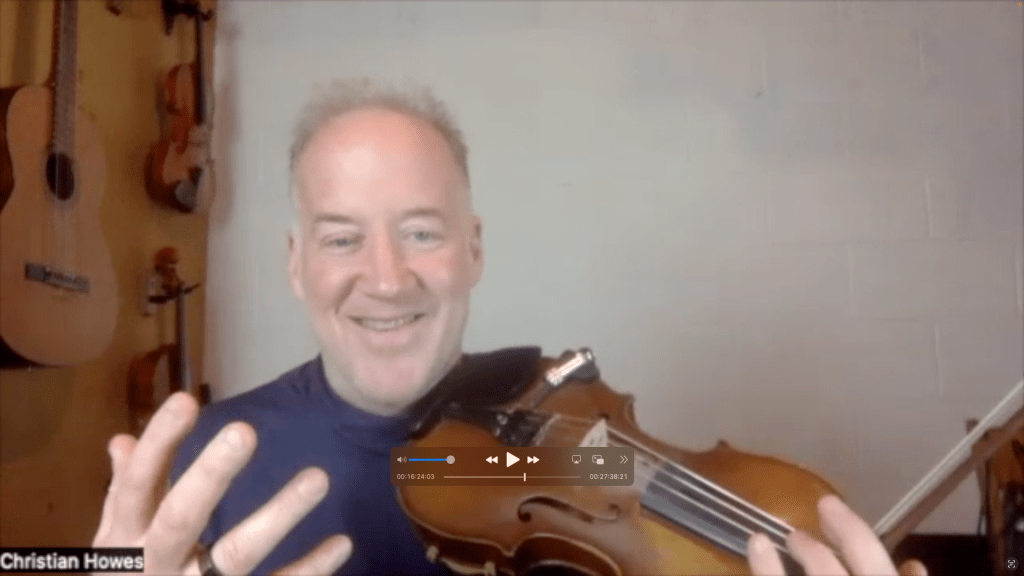
This is an interview with Christian Howes (https://christianhowes.com/). He is a renowned violinist, educator, and entrepreneur. He’s a classically trained musician who has attained prominence as a jazz improviser. Chris has developed a systematic and comprehensive approach to teaching improvisation, empowering musicians of all levels to unlock their innate musical creativity. He integrates insights from meditation and yoga into his pedagogy, adding a unique dimension to the learning process.
This interview includes an overview of Chris’ methodology for learning to improvise, a demonstration of how he integrates meditation into his approach, and background on how he developed his philosophy and what effect it has had on musicians.
The musical interlude features a fragment from this presentation by Dr. Susan Rowland: • Jungian Arts-Base… The music was composed and performed by Bradley Vines on alto and baritone saxophones.
Unedited Otter.ai generated transcript:
Bradley Vines 0:00
Greetings all. Welcome back to another episode of the neuroscience of improvisation. I’m your host Bradley vines. And today we have a truly exceptional guest. Christian house is a renowned violinist, educator and entrepreneur. He’s a classically trained musician who has attained prominence as an improviser, Chris has developed a systematic and comprehensive approach to teaching improvisation, empowering musicians of all levels to unlock their innate musical creativity. He integrates insights from meditation and yoga into his pedagogy, adding a unique dimension to the learning process. Today, we have the opportunity to explore the depths of Christian house unique musical philosophy. Prepare yourself to expand your musical horizons.
Speaker 1 0:58
This program support exploring consciousness.
Susan Rowland 1:02
Absolutely. Absolutely.
Bradley Vines 1:05
Okay. Wow, this is wonderful. So delighted to have this chance to chat with you, Chris. Let’s just jump right in. You have helped so many musicians to discover and nurture their voices as improvisers I would love to know if you can share what you’ve seen in terms of the effects that improvising has had on their lives on them as people. If you have any specific examples, of course, that’d be amazing to hear about.
Christian Howes 1:41
Sure you work with a wide range of musicians from amateur, like adult beginners, and also like elite classical players, because it tends to be a lot of both string players. And, you know, it’s really coming out of my own experience from when I was young, and I was a classically trained player, but I felt really unsure about improvisation, I felt insecure about it, I felt like it was a complete mystery. And, you know, and then I just kind of beat myself up about it, you know, and I was either in denial about it or just beating myself up. And then sort of for a long time, I’ve been trying to seek the place that I think I’ve kind of family finally found, which is like just accepting myself for who I am and where I’m at as a musician. And so, lately, that’s been really what I’ve been focused on with the musicians that I help. And just seeing that a lot of them suffer from the similar things like they could be a totally elite, musician, classical musician, but they’re just really afraid about improvisation. And it’s not just improvisation, it’s like harmony. It’s like different stylistic languages or rhythmic contexts. So I actually break up these different things into separate problems. Because I think that when people try to improvise over a harmonic structure, or a rhythmic structure or a song, they don’t know, the problem is not improvisation. The problem is they don’t know that stuff. And so what I’ve been really doing is trying to help people with improvisation by giving them problems or situations that are easy for them to deal with, like, at their level. And what it does is, is when people go through that training, you know, with me, if they come to like my Zoom classes, or my retreats, or whatever, they they feel better about themselves, they have more clarity. And I think one of the central reasons is, because if you’re like a well trained classical musician, then and you can’t improvise, well, I think a lot of people, they make an assumption that it means they’re not a good musician. Like, if I’m a great musician, I should be able to improvise, I should just be able to hear my way to do it. But if I can’t do that there’s something wrong with me, or everybody’s gonna see that I’m a fraud, that I’m the fake. This gets to the heart of the problem, though, of us like putting our self worth with our musical ability, and then having these unfair expectations that we set for ourselves. So I tried to give people a process, but as a gateway to hopefully help them then feel better about themselves. And what I’ve been doing more than I know why I’m so interested in your work in the last year or two is actually using improvisation to facilitate a more meditative state and actually giving people like mindful prompts while they’re playing. Kind of like a yoga teacher would, or like a martial arts teacher or like a meditative, like. Guided Meditation would like giving them constant reminders to focus their intention on their breath on their body. And giving them just kind of like, I don’t know, mantras or quotes to hold on to so that they can show To develop a more self appreciation,
Bradley Vines 5:03
I was going to ask you about your your interest in meditation and how you’re integrating that into into your practice and, and teaching and mentoring of improvisers. So that’s, that’s amazing. You’re so you’re, you’re finding ways to give them cues to help that help maintain the state of mind. That’s, that’s free of judgment. And that’s involved in the music and, and spontaneous. Is that, is that the idea? Yeah, I
Christian Howes 5:37
mean, we can even try, like, if people are listening, if they have their instrument, like I even show you what I can even show you what it looks like. Right? Please. Okay, so anybody that’s listening, what I want you to do is you can either you can either sing, or you can play your instrument, and I’m going to try to guide you through a meditation just for like, one minute. All right. So take your instrument, or prepare your voice. And just before you start to play, I just want you to take a second ground yourself. Just breathe, just notice your breath. And maybe set an intention for what you want to do in the next minute. How do you want to feel? What kind of energy do you want to create? Is it peaceful energy? Do you want to feel more balanced? Do you want to feel integrated? Do you want to feel competent? Do you want to feel confident? Do you want to feel strong, just just think about that for a second. And now, in just a second, I’m going to ask you to choose one note. And I want you to just hold that note, in just a second, I’m going to tell you to just pick that one note, and then just play it. Okay, ready, take the one note and just play it for a long time, about 20 seconds, go ahead. And as you’re playing that note, I want you to just focus on your breath. If you’re, if you’re bowing your violin, just keep your bow moving. If you’re holding a note on the piano, maybe you just keep pressing the note whenever you want. If you’re blowing a note in your horn, maybe you run out of breath. And then you just play again. Just notice your breath. When you’re ready, change the note and just hold it for a long time. Notice your breath. Maybe notice your shoulders, neck. If there’s any tension in your face, just notice. If you want you can change the note again, change the note. Any note you want. You can notice your sound. Notice your intonation. Notice your vibrato. When you’re ready to change the note again, if you need to take a breath or take your ball off the string, go ahead and do so start another note. Hold that note. Notice whether you’re getting louder, whether you’re getting softer. And come back to your breath. And come back to your intention. And when you’re ready, stop playing. That’s an example.
Bradley Vines 8:34
Oh, that’s fascinating. Yeah, I was playing in my mind imagining playing a while you were doing that. And it’s amazing that the next note kind of just came to me. You know, I imagined the next fingering and the next note I wanted to play when you said now play another note. And then it just comes. It feels like it kind of connects with something natural. When you’re dealing with it that way. It just it’s happening of its own, you’re going with the flow and there’s no need to think hard about this. It’s just it’s what it what is emerging. So that seems like a really interesting way to move people into that state of mind non judgmental, open to associations and natural progressions that are going to emerge from their nonconscious. Is that kind of what you’re looking for. How do you? What do people say about this approach? And how do you think about it?
Christian Howes 9:42
Yeah, so I think there’s two there’s two parts of it. So one is I’m trying to develop this, this kind of language of an arc of like, a guided meditative practice, such as they do in martial arts or yoga, right. There’s these common prompts that people give, if you go to a yoga class, it’s like, notice where you are right now recognize that wherever you write are right now that that’s enough that you’re exactly where you need to be, you know, bring your attention, you know, bringing your attention to things and practicing, bring your attention, centering on the breath, you know, other little mantras that people say, I think are really helpful for facilitating that positive mindset. So that’s part of it, that I’m trying to learn that the other part of it with that I think as a kind of like a secret to giving people success with improvisation is specificity.
Really, really limiting people’s choices. So I’ll give you an example like, and I think that jazz studies really blows it in a major way on a lot of levels, from a standpoint of bringing people into the fold. Not everybody, but as a general rule. You know, everybody’s heard about like the blues clinic, like the, you know, where it’s like, Hey, let me teach you the pentatonic scale. Okay, now, here’s a blues, and this is what it is. And now just use the notes in that pentatonic scale and just play whatever you want, right. And there can be some limited success with that, but I find it more often, there’s not enough specificity. Number one, it’s too much choice. So in my case, like in the case of what I just did, part of the reason that that works is because I said, pick a note and play it. Now. There’s a lot of specificity there, that’s very different than saying play whatever you want, and choose from this scale. So there will be other ways I could do that, though. Like I could say, like, you know, play one note recurring at this tempo. Or choose from these three notes and play this recurring tempo. So there’s a lot of ways that I find to give people specific parameters many, many more ways. And so those are kind of the two sides. One side of it is that I’m trying to give people these mindful prompts. The other side is that I’m giving them different what I call forms, elemental forms, where they can have absolute success and improvisation. In the same way that like, if you go to yoga, you’re doing poses, their forms, like standing mountain pose, is like literally like, Well, anybody who has two legs can do it. Right? Like you can just stand. And so it’s in that standing that then you can find expression, but it’s because you’re comfortable, because you know, you can do it. And it’s the same thing with down dog or like, you know, whatever the different poses are, like, I can’t do them well, but I can do them. And with that constant affirmation of the teacher that just like just breathe in the pose. You settle into a deeper sense of, of confidence and ease. And then when you practice it over and over again, you get better at it. So there’s no, there’s no need to be able to play giant steps. It doesn’t matter. I don’t know if I answered your question or if
Bradley Vines 13:38
I deviate too, Oh, definitely. And it does align with the research on the neuroscience of improvisation and that there’s evidence that even just subtle small changes can lead to significant changes in brain activity. So research looking at playing precomposed music that’s been practiced and rehearsed in a certain way, versus playing that that same music, but with in profit, Satori, mindset, or being more spontaneous, maybe stretching certain notes, or adjust the dynamics or introduce maybe a little grace note here and there. And just having that different approach leads to the change in brain activity that’s unique to the improvisation, Tori state. You’re getting to the point of recognizing that we kind of have these ideas that to improvise is to play complex music and very challenging music. Whereas actually to enter into these different states of mind, just very simple structures and contexts and changes can totally alter our experience.
Christian Howes 14:57
Yeah, and then you don’t want that things I do is I really separate learning from improvising. So like, you know, because, because if you want to play giant steps, or if you want to play blues or like, you know, then there has to be a lot of learning that takes place. But I think so many people, they try to improvise before they’ve done the learning. And so what I liked it, what I like to give students is like, Okay, here’s ways to like, learn material. And then here’s a process for improvising over in a context where you’re completely comfortable. Like, let’s say another, another student might be comfortable enough with like, the C major scale, in extended range like this is C, but I want to play C and extended range on the violin, which is here. Right, so let’s say a student is comfortable, if they are comfortable with that, that I might say, okay, so, choosing from just those notes, play in a recurring rhythm, you know, like, quarter notes.
On and on and on. And I might ask them to do it for like, at least a minute, or maybe two minutes, because I think just like yoga, if you, if you do a pose for like, eight seconds, it’s not the same, you don’t really get the benefit unless you do it, you know, a lot, though, or longer. And so I’ll ask them to do something like that. But again, there’s many more variations. But they’re within their comfort zone. But a lot of times what musicians will do when I ask them to play like that exercise, is they’ll try to make like a melody that someone would sing or that they think we should be perfectly formed somehow, or that sounds like something like don’t play like, you know.
Which I’m not asking them to make a song that sounds like a song with a chord progression. Like, I’m not asking that I’m literally like, and then I’ll tell them like, actually try to play the most wrong note you can, you know.
Because then I feel that’ll actually open them up more, because there’s, there’s a tension that they’re feeling about, they’re trying to do something else. They’re trying to compose this, this masterpiece on the spot, or they’re trying to internalize some, like, you know, pre plan, some chord progression. That’s not the exercise. The exercise is to be in the form. You know what I mean? Like, in the purest sense,
Bradley Vines 17:51
that’s, that’s beautiful. And I really haven’t seen this anywhere. So this is this is your creation, this, this approach to developing improvisation? Or where did you learn this? Or come up with this?
Christian Howes 18:09
Well, I mean, I was really kind of wrestling with these, you know, you know, because because, because as a classical musician, the only all I had was like the things I’d heard, which was very melodic, as a violinist, but there was no harmonic understanding beneath it. Like I had studied Bartok, string quartets. And Krakoff even played all this like bearhug and stuff like that in orchestra like, plus obviously, Mozart and Beethoven and all that stuff. But um, you know, I heard a lot of this like, modern classical, just melodies I could I could find those shapes was a lot easier for me to just melodically. Listen for that. And I was like, I can’t get this harmony thing, especially with a single note load, mainly single instrument. It’s like, it’s hard to like, hear the song with all occasions. So I would just explore I guess what you might say is chromatic improvisation or 12 tone improvisation. Because I just wanted to find a way to just develop a language so but it’s been it’s been a long process to come to this point of a really refining like a method.
Bradley Vines 19:28
Yeah, yeah. It must because it’s, it does feel refined and kind of broken down to the bare bones of what is musical spontaneous, spontaneity, what is being present and being creative in the moment. And what’s necessary for that the most basic elements that then have within them, all of the magic that you can experience at any scale. of musical creation. So I find that really fascinating. And how does your method does is is that where I mean, I can imagine just being there? Is there a trajectory to the learning where the forms enable people to your people that are learning this approach to improvise together? And how does it build? Yeah.
Christian Howes 20:30
Well, absolutely, like so what’s interesting about this is that I’m glad you asked that question. Because like, Well, there’s two kinds of building I guess, in my mind, because if the question is, well, how do you build from that into being able to play giant steps? The answer is, you take separate time where you’re just learning material, like so for example, like voice lead practice voice leading to chords back and forth, you know, really exhaustively until you can do those, and then you can improvise over that small amount of material, which like, you know, the pianos Bill Evans famously talked about that he would just had a very small amount of material and for an hour, he would practice, that’s what he would practice, he was practicing a very small amount of material. But when you separate learning from improvising, and it’s just like, Okay, now I’m practicing, you know, voice leadings. That’s memorization. And actually, you know, if it’s like, okay, I have 15 minutes that I’m working on voice leading. That’s pretty doable, then I’ve got 15 minutes that I’m doing improvisation. On something that I know really well. Whether that’s a out of a key signature or not, whether it’s over like a simple chordal voice leading pattern or something like that, or a rhythmic pattern. So that’s, that’s one way that we build. But also, in this process of this mindful improvisation we’re trying to reinforce for people that don’t try to be somewhere where you’re not be where you are. And be like Victor Wooten said in the music lesson like second chapter, he said, Never lose the groove in order to find a note. And the discipline of playing within your means everybody’s trying to, like, play faster, or be more complex or be more interesting. And it’s like, no, you’ll be so much more musical, if you just take less chances, and do what you can do. Well, everybody knows this, like great musicians know this, right? So just reinforcing this, like, don’t quit trying to be somebody you’re not except where you are. And, and, and, and have a state of peacefulness, when you’re playing, have a state of competence of restraint of discipline. And some of the things like like Bobby Floyd, who is a great B three organ player and jazz pianist who toured with Ray Charles, he’s a legend, University of streets, Columbus, Ohio. One of the things when I when I was learning from him was that, like, every note he plays is in rhythm. So for example, like I will set for myself, if I’m improvising, I will set as one metric, or even the only metric. It doesn’t matter what I play, but every note I play will be in rhythm. And if I adhere to that standard, like it’ll be in time, right? If I adhere to that standard, it means that I have to not play. And so holding people to not playing is actually more important than you know. But if you could say the same thing about playing in the changes, or playing complete phrases, or playing with a good sound, or whatever, it’s like, whatever standard, you’re going to hold yourself to have the discipline to not play, and unless you’re going to play that way. So that’s one side of building. But the other side of the way I would answer your question is like, you can have two people play free notes together. And it’s very, it’s very interesting. Like I can pretend to be two people and say, well, both people are going to play together in time, just random notes.
And if two people do that together, and they’re listening to each other, like It is musical is beautiful. And the reason why is because they’re playing together. They’re matching their sound, they’re playing in tune. There’s a human intention, there’s a unity with it. So that’s already building music that’s totally spontaneous. It has a form. And it’s enough. It’s enough. Just like if you see a tree out your window, that tree is enough. The tree is not lesser than the other tree on the other side. It’s just a different tree. But it’s beautiful. It’s it’s, as you were saying, like a found object. Maybe that was the our other conversation.
Bradley Vines 25:36
Absolutely. Okay. Well, I mean, it’s enormous and enormous grocery store of food for thought. And, and I think it’s really great, what you’re doing. And so how can how can people get involved in learning through your method? And I know you’re, you’re on the East Coast, more or less? And do you have a presence elsewhere in the country? Or is that all done via online interaction? Or how do people connect with you and, and take part and learn from you?
Christian Howes 26:15
Yo, thanks for asking. You know, I’m in Asheville, North Carolina, but, but I do a lot online. I teach a lot of people online a lot of different ways. One thing I recommend people do is go to my YouTube channel and just play with my free play long videos. I’ve got hundreds of play free play long videos, a lot of them are like play after me. So I’ll play like a short phrase. And you can play it back after me. I have in different styles, different different levels, so easy to advanced. And, but I also do zoom classes where I’m guiding people through improvisational exercises over seven weeks, take him through my whole curriculum. So you can go Christian house, you can find me there, you can go to my YouTube channel, Christian house.com, or YouTube. Probably the easiest way to go to my website, Christian house.com. Thanks for asking.
Bradley Vines 27:01
Yeah, absolutely. And thank you for sharing that and playing as well. What a treat. I love your playing on your podcast episodes, what you share. The musical excerpts are always wonderful here to hear. So it’s great to hear it live. Indeed. Okay, wonderful. Well, thank you so much, Chris. It’s it’s a real pleasure and an honor indeed to have you in conversation so much. Appreciate it.
Unknown Speaker 27:35
Appreciate you. Thanks a lot, bro.
Transcribed by https://otter.ai
 Bradley Vines, PhD, MBA