This workshop provides an overview of developments in AI involving music creation and improvisation, including a high-level exploration of how these systems work. The emphasis will be on similarities and differences between AI-generative music and (human) musical creativity, as well as insights from this comparison for the practice and experience of improvisation. There will be guided “experiments” in improvisation that bridge the research with your musical practice.
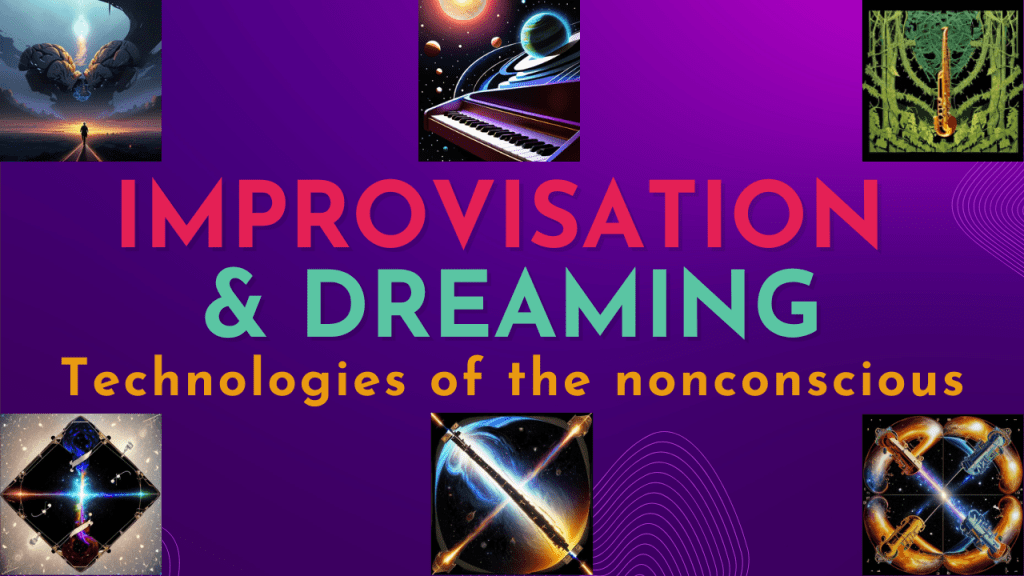
In this program, we compare dreaming and improvisation focusing on creative synergies, experiential similarities, and the underlying neurophysiology. These states of mind are mutually illuminating. That is, learning about one provides insights into the other. A key insight here is that we can deepen our understanding of improvisation by exploring other states of mind that have overlapping experiential qualities or brain states. In his book Dreams of Awakening, Charlie Morley writes that “…there are many different ways to tell the difference between [different states of experience], but the easiest way to get to grips with these differences is to spend as much time as we can in these states.” I propose that this is the case for improvisation, as well. By paying more attention to our dreaming experiences, we may deepen our knowledge of the experience of improvisation.
Braun, A. R., Balkin, T. J., Wesenten, N. J., Carson, R. E., Varga, M., Baldwin, P., … & Herscovitch, P. (1997). Regional cerebral blood flow throughout the sleep-wake cycle. An H2 (15) O PET study. Brain: a journal of neurology, 120(7), 1173-1197.
Kraehenmann, R. (2017). Dreams and psychedelics: neurophenomenological comparison and therapeutic implications. Current neuropharmacology, 15(7), 1032-1042.
Limb, C. J., & Braun, A. R. (2008). Neural substrates of spontaneous musical performance: An fMRI study of jazz improvisation. PLoS one, 3(2), e1679.
Liu, S., Chow, H. M., Xu, Y., Erkkinen, M. G., Swett, K. E., Eagle, M. W., … & Braun, A. R. (2012). Neural correlates of lyrical improvisation: an fMRI study of freestyle rap. Scientific reports, 2(1), 834.
Rosen, D. S., Oh, Y., Erickson, B., Zhang, F. Z., Kim, Y. E., & Kounios, J. (2020). Dual-process contributions to creativity in jazz improvisations: An SPM-EEG study. NeuroImage, 213, 116632.
Walker, M. P., & van Der Helm, E. (2009). Overnight therapy? The role of sleep in emotional brain processing. Psychological bulletin, 135(5), 731.
Trehub, S. E., Ghazban, N., & Corbeil, M. (2015). Musical affect regulation in infancy. Annals of the New York Academy of Sciences, 1337(1), 186-192.
Shenfield, T., Trehub, S. E., & Nakata, T. (2003). Maternal singing modulates infant arousal. Psychology of music, 31(4), 365-375.
Terry, P. C., Karageorghis, C. I., Curran, M. L., Martin, O. V., & Parsons-Smith, R. L. (2020). Effects of music in exercise and sport: A meta-analytic review. Psychological bulletin, 146(2), 91.
Bradley Vines 0:00 Greetings, and welcome to the neuroscience of improvisation. I am your host Bradley vines. In this program, we’ll be comparing dreaming and improvisation in terms of creative synergies, experiential similarities and the underlying neurophysiology. These states of mind are mutually illuminating. That is, if you learn about one, it will provide insight into the other. I think that a key takeaway here is that we can deepen our understanding of improvisation by exploring other states of mind that have overlapping experiential qualities or brain states. In his book, dreams of awakening, Charlie Morley writes that there are many different ways to tell the difference between different states of experience or consciousness. But the easiest way to get to grips with these differences is to spend as much time as we can in the States. I agree with this. And I propose that this is the case for improvisation as well. Pay more attention to your dreaming experiences. And I believe that you will become more knowledgeable about the experience of improvisation.
Bradley Vines 1:30 So what about dreaming starting with comparing improvisation and dreaming? I’m going to talk about synergies, and then phenomenological, or experiential similarities, and then neurological contrasts. So starting with dreaming and looking at synergies. So across the art world, there have been so many examples of dreams influencing art, think Salvador Dali, and just the endless examples in science and throughout human history and human endeavors. But certainly in music, we have Rahsaan, Roland Kirk, he actually, his wife said his religion was the religion of dreams. And here’s an Here’s a little clip showing, or with audio of him speaking about how he developed the idea to play multiple instruments if you don’t if you’re not familiar with his work. He was a great innovator in jazz and, and provident jazz music in general. And it wasn’t a gimmick, he was a real expression of his mind to add, playing multiple saxophones and other horns at one time. So here’s how he describes how he came to this idea.
Rahsaan Roland Kirk 2:50 Well, I just came from a whole lot of different dreams that I was having. And I was the sort of frustrated after practice day in and day out, and I’d lay down I have these dreams, I’d hear different instruments simultaneously and one of the dreams is quite clear, because it showed me plan to instrument simultaneously. So after that, I set out to have fun instruments that I heard in my dreams by looking in antique shops, different type of music shops.
Bradley Vines 3:29 Yeah, so he saw this in a dream and then brought it into reality. Albert Eiler wrote that through meditation, dreams and visions, I have been made a universal man. And then there are examples of composers talking about their experience like Brahms, saying that he enters into a semi trance condition, when the conscious mind is in temporary abeyance and the subconscious mind is in control. And that’s when these gems, these uncut diamonds, so to speak, emerge for him the core ideas behind compositions, Mozart similarly said that his ideas come, this that is, this inventing, this producing takes place in a pleasing and lively dream. So, this kind of liminal state of dreaminess seems to be the origin of many creative insights and idea. So how are the experiences of dreaming and, and improvisation similar so if we look at the phenomenology that means by that I mean, the experience of improvisation and dreaming, what are they like? Well, they both have this narrative quality, don’t they? They kind of flow And this unfolding, so to speak. And there’s a wonderful clip from I called him Morgan, Lee Morgan, the Lee Morgan, documentary.
Wayne Shorter 5:14 And sometimes we were playing, and he was playing a solo. And art will be yelling Philly. Talk to the people to talk to the people to tell them your story told me a story that he knew how to tell a story musically.
Bradley Vines 5:35 Okay, that was went shorter talking. And what does it mean to tell a story? Charles Lloyd has talked about communicating through music. So he talked about, well, let me let him speak for himself. Here’s a little clip of him speaking.
Charles Lloyd 5:55 If I can articulate it, I guess I wouldn’t have a need to play it.
Bradley Vines 6:01 So his his basically saying he has something to say, and he can’t say it in words. So he’s going to say it in music. And this is from another wonderful documentary about him called arrows to infinity, if you want to take a look at that one. So that’s narrative qualities, you’ve got this kind of the sense of a narrative that’s forming over the course of an improvisation and through a dream, then there’s the loss of agency. So when you’re dreaming, you’re not in conscious control. It’s happening to you, unless it’s a lucid dream. And then there’s some conscious control. Anyway, that’s a different discussion. Normal dreams are basically just unfolding, and they’re not really within your control, at least the main elements where you are what’s happening. So similarly, the experience of improvisers can be like this. There can be a loss of agents as well, Billy Higgins said, We are not playing this music, we are instruments of what he called the Most High, or Charles Lloyd again, the the tenor player, said the music is not my music, I’m a conduit, it comes through me I am in service. And then this idea, or this experience of the movement via adjacency. So what does that mean? It just means that you move through things that are tangentially connected to where you are now. So in a dream, you’re, it’s no problem to jump to a fully different kind of scene, as long as there’s some link connecting you with from one scene to the next in the dream, you might see some very unusual leaps in your dream progression. The same thing can happen with, with improvisation, of course. So these researchers, zodra and sickled. They said the dream stitches, a series of memories, and network explorations, that means your memory network together, keeping a principle of adjacency and operations, so these connections via via tangents, that kind of bridge between different disparate ideas. And this happens, for example, in improvisation when someone inserts a quote, so you’re playing one song, but suddenly the improviser here’s another song and in, creates that, so here’s kind of a description of how Charlie Parker did this. In relation to the Stravinsky piece, ba ba, ba,
Kansas City PBS documentary Bird: Not Out Of Nowhere | Charlie Parker’s Kansas City Legacy 8:52 ba ba. Okay, in the middle of this fast song, Charlie Parker, his jump jumps in his solo and is going at this breakneck speed. And then, at the beginning of his second course, he inserted the opening of Stravinsky’s Firebird Suite. Stravinsky is in the audience. Immediately, Stravinsky stopped pounding the table, he went to you this jazz musician that he’d been hearing about. And now to hear him live sitting up there, he’s sitting out here, and now all of a sudden at this breakneck speed in the middle of his improvisation, he plays one of his compositions, spots, spontaneously, I
Bradley Vines 9:36 forgot to mention the context that Charlie Parker notice that Stravinsky was there. And so that would have been the adjacency there. So it led to this connection with another piece of music that normally wouldn’t go in that piece. And you can find infinite or many examples of inserting quotes from other people. Cities are taking from other solos and improvisation, of course. And then you have these unexpected twists and turns and improvisation, perhaps most clearly communicated in this story by Oliver Sacks about a patient of his who had Tourette Syndrome. This patient Ray was a jazz drummer. And Tourette’s, of course, leads to these sudden movements that are unexpected and uncontrolled. And he would, as a jazz drummer simply let those become the kernel of a new direction for his improvisation. So suddenly, it’s a new idea that takes them off in a new direction. And we’re all doing this when we’re improvising. But our surprising moments are coming from these unexpected places, perhaps. Okay, so that’s experiential. experientially, that similarity between dreaming and improvisation. What about neurological similarities? So it turns out that rapid eye movement dreaming, and I’ll say high quality improvisation. So this is like experts or people very comfortable with a particular setting. And they feel like it was a good improvisation. They both involve a decrease in activity in the frontal lobes. And these are areas that we’ve been talking about as being important for executive functioning. So you might think that there would be more involvement of these high level areas in improvisation, where you have to come up with new stuff. But actually, there’s a decrease when we let our guard down, so to speak, we stopped judging ourselves, it allows these non conscious procedural memories we’ve developed to express themselves. And this change, this decrease in frontal activity is found both in dreaming and improvisation. So this shows how you’re entering into a state of mind that has something like dreaming in it. And they both interestingly, involve a decrease in the stress response. Dreaming is kind of, from what I understand, it’s it’s kind of our built in psychological therapist. So when you dream about something traumatic, the degree of trauma that you experienced in relation to that idea or or experience actually reduces after your dream, normally, for normally functioning dreams. And it’s actually a, a sign of a problem when dreaming doesn’t lead to a decrease in trauma. And it’s actually one of the criteria that they use to determine if someone has PTSD. If their dreams are not helping them to process that event, then something is broken down, we need to find some other way to to fill in for that natural process. But for most, most of the time, dreaming is helping to have a therapeutic effect. And interestingly, music does something very similar. So music reduces stress, it is shown to reduce stress hormones do release oxytocin, as I mentioned. So it may be inducing a state that’s like dreaming. Now, I’ve just realized I forgot to mention that dreaming not only decreases frontal activity, but it’s associated with a decrease in stress related hormones. So that’s the complete equation. So both dreaming, and music, are associated with a well at least improvisation, a decrease in activity in the frontal cortex, the dorsal lateral prefrontal cortex in particular, and a decrease in stress related hormones. So that may be why improvisation is especially therapeutic. Here’s a little description of from Hank Green on the same show about the relationship between improvisation and dreaming. In
Hank Green 14:30 fact, the same patterns of activity we see in improvising musicians also show up during REM sleep, the phase of sleep that lets us dream and this kind of makes sense, right? Dreaming is all about strange, unplanned associations, and a lack of control. So it’s easy to see why those same traits produced by those same brain areas produce that same feeling of other worldly inspiration that musicians report while they improvise.
This episode shares overviews of seminal neuroimaging studies that provide insights into what happens in the brain during improvisation. You will learn how these findings align with what improvisers say about their experiences, including remarks from Bill Evans, Sonny Rollins, Kenny Werner, Pat Metheny, and Gary Burton. Cross-cultural perspectives are included here, as well, including reference to a traditional Japanese visual art form and traditional perspectives from West Africa.
Unedited transcription of the episode by Otter.ai:
Bradley Vines 0:00 Greetings, and welcome to the neuroscience of improvisation. In this episode, we are finally wading into scientific research. I will share overviews of seminal neuroimaging studies that provide insights into what happens in the brain during improvisation. You will learn how these findings align in interesting ways with what improvisers say about their own experiences, including remarks from Bill Evans, Sonny Rollins, Kenny Werner, Pat Metheny, and Gary Burton. There are also cross cultural perspectives included here, including reference to a traditional Japanese visual art form and traditional perspectives from West Africa.
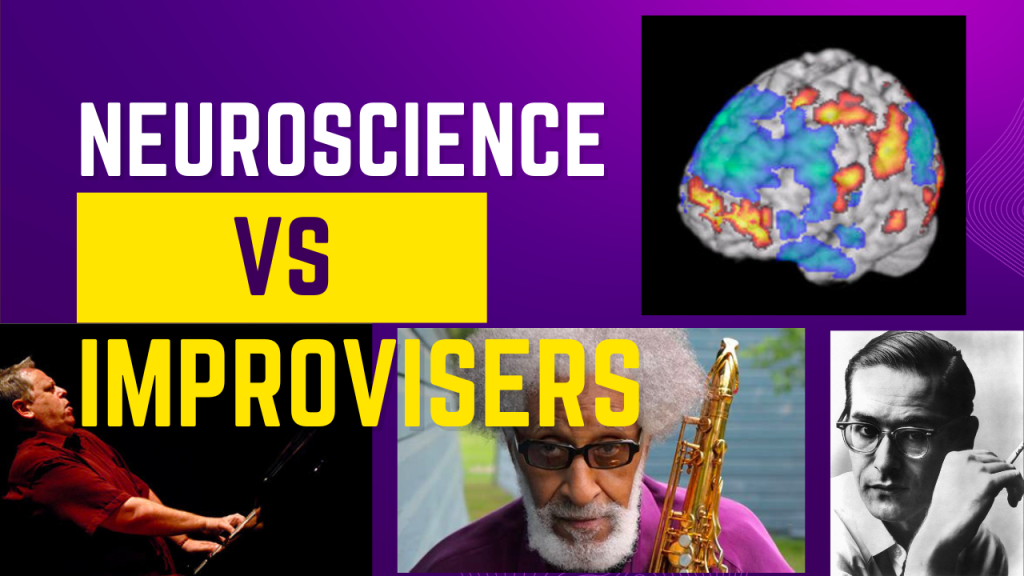
Let’s jump right into the most famous improvisation neuroimaging study. This was conducted by Charles Lim and colleagues. He was at the time at Johns Hopkins. He’s now at the University of California, San Francisco. And what he did was to have jazz pianists. So these were professional improvisers. He had them play in two different ways in an improvisatory way. So they’re improv improvising over a 12 bar blues form, for example, versus having them play a pre memorized piece over 12 bar blues forms. So that was the comparison looking at improvisation versus performance that has similar complexity in terms of the motor requirements for the task. But it’s pre learned. So pre learned versus improvisation, or you don’t know, of course, what’s going to happen, creating it in the moment. And what he found us was quite interesting. And, to me, strike me as a bit paradoxical. So I would have thought that improvisation would require more brain activity. After all, it seems more complex, you’re having come up with something in the moment, you’re having to create something new. But actually, what he found was the dominant finding the most interesting finding at least, was a dampening down of activity, there was less activity in a certain area of the brain, that it well, it’s the dorsal lateral prefrontal cortex, that will come up a few times, but it’s here in the frontal cortex. And that is the area that is responsible for self control, rational conscious monitoring, and, and so on. So this area of the brain that’s normally active to help filter what we’re doing help keep us in line so to speak with with the norms of the situation was dampened down interestingly, and there was a concomitant increase in activity in areas involved in sensation and internal motivations, including the medial frontal cortex, and areas of somatosensory cortex. So there’s, there’s this trade off, it seems, where in the impervious Tory state, you have a decrease in self monitoring, and control volitional control, and an increase in the structures that are involved in internal motivation. Notably, Lou and colleagues found a similar finding a very similar pattern and results. We’re looking at freestyle rappers, so people that were not jazz pianists, but freestyle rapping artists, and they again compared pre learned versus improvised states performance situations, and found a very similar pattern to those that lemon colleagues found. Okay, now, the story isn’t quite so simple. As you know, just stop using your your self monitoring, and you’ll be a fantastic performer and you’ll rise to the occasion. Turns out that it’s likely that the story is related to your level of experience and also familiarity with the current situation. So David Rosen and colleagues did some very interesting research, where they looked at the quality of the improvisation. So not just whether someone was improvising but how or high the quality or enjoyment or pleasure of that improvisation was based on the performers own experience, but also listeners. And what they found, in some ways does go along with what Charles Lamb and colleagues found in that. When there was decreased activity in frontal regions, the more experienced improvisers had higher quality improvisation. So there was this correlation where the less activity in the frontal areas led to higher quality. However, this was only for the experienced improvisers. less experienced experienced improvisers saw exactly the opposite trend. So the less activity in frontal regions, the less quality in the improvisations. So it’s quite interesting to see that this involves familiarity and experience. And basically, there was a replication that Roseanne and colleagues conducted where they actually stimulated this prefrontal cortex area, using a technique called transcranial direct direct current stimulation, which allows you to increase or decrease activity in an area so they increased activity in the dorsal lateral prefrontal cortex of the right hemisphere. And they found that this actually impeded quality for the experienced improvisers, whereas it actually improved quality of performance for the less experienced improvisers. So. So the story is that using these frontal self monitoring areas might be very helpful. When we are less familiar with a particular situation, or with a particular piece that we’re performing through or structure. Think of when you’re learning to drive, of course, when you first start, you want to be quite vigilant and concerned about what you’re doing, where you’re putting your foot and so on. But over time, that falls to the background. And you’re able to basically do that implicitly. And that’s more or less what we’re seeing evidence of here in the context of improvisation. So what we’re seeing here is a pattern that connects improvisation with the idea of expression, spontaneous expression, without filter, so to speak. And this is probably not a new idea for all of you. One of the most famous albums of all time, of course, kind of blue features, liner notes by the incomparable Bill Evans, who beautifully writes in these liner notes, about impromptus, Satori, Japanese visual art form, these artists must practice a particular discipline, that of allowing the idea to express itself in communication with their hands, in such a way, such a direct way that deliberation cannot interfere. So this nicely aligns with what we’re finding thus far in, in this young burgeoning field of research on the neuroscience of improvisation. And you’ll find lots of statements that are like this across musicians. But certainly Ron says it as well as anyone else, you know, what I’m basically trying to do is blot out my mind. And of course, I’ve already learned the materials, it’s just letting the material come forth. This is from a great documentary, saxophone Colossus, and it aligns with what Kenny Werner is saying, in effortless mastery. If
Kenny Werner 9:06 I witness the piano being played, well changes in neurology quite a bit. So it’s not my responsibility. You could simulate it by watching someone else move their hands on the piano. And notice that you’re not involved at all. Because in your mind, you’re watching someone else play. Then you just look oh, look, his hands are moving. And I feel in no way responsible for where they’re going. The neurology of the first two steps is to be able to experience that, although it’s you so it has the neurological component of surgically removing the responsibility.
Bradley Vines 9:49 The jazz guitarist Pat Metheny has also discussed improvisation in a similar way. Here is a quote from his presentation At the Society for Neuroscience conference in 2018,
Pat Metheny 10:05 I want to be able to really be in the moment, at the most micro level possible while essentially being almost removed from it. I often describe my relationship to at all as being a fan of music a listener first. At my best, I don’t even feel like I’m doing anything. I’m just standing there listening. And if there happened to be a guitar player there, which there is, and it happens to be me, what would I like to hear that player do and then I play that. But the entire process I just described happens in almost real time. less than a millisecond, I would say, Gary
Bradley Vines 10:41 Burton, the wonderful jazz vibraphonist and educator, put it this way.
Gary Burton 10:47 And now when I start to play, I sort of take a mental step backward in a way and I start watching the playing. Soon as I started tune, I mentally I’m just watching the plane go down as if someone else is playing. And my conscious mind is disengaged from choosing notes and all that sort of thing. The rule is, the conscious mind can do anything it wants to, except get in the way. You can think about random stuff, you can watch the music happen, you can concentrate on the tune, feel and so on, but you can’t interfere with the flow. The following
Bradley Vines 11:30 is a comment about what seems to be the same state of mind you’ve just heard described by improvisers. But from a very different cultural context, that of a community in Burkina Faso, West Africa. You will hear Dr. O’Malley DOMA. So me talking about the traditional perspective on performance more generally, that is not limited to music or improvisation, but including all human endeavors. So
Maladoma Some 12:00 it really raises the issue of, of knowledge. That’s why I’m saying that, you know, it’s, it raises an epistemological challenge here. Is that you the know how to do what you do?
Bradley Vines 12:15 Or is it something else that is doing the thing and knowing the doing and therefore taking over your hands, your feet, your mouth and your whole body? In summary, we have explored some interesting correspondences between what’s happening in the brain during improvisation and what improvisers report about their experience. We have opened the door to cross cultural perspectives on the states of mind. And going forward, we will delve deeper into the neural mechanisms underlying improvisation and what they reveal about the relationship between improvisation and dreaming meditation, psychedelics and consciousness more generally.
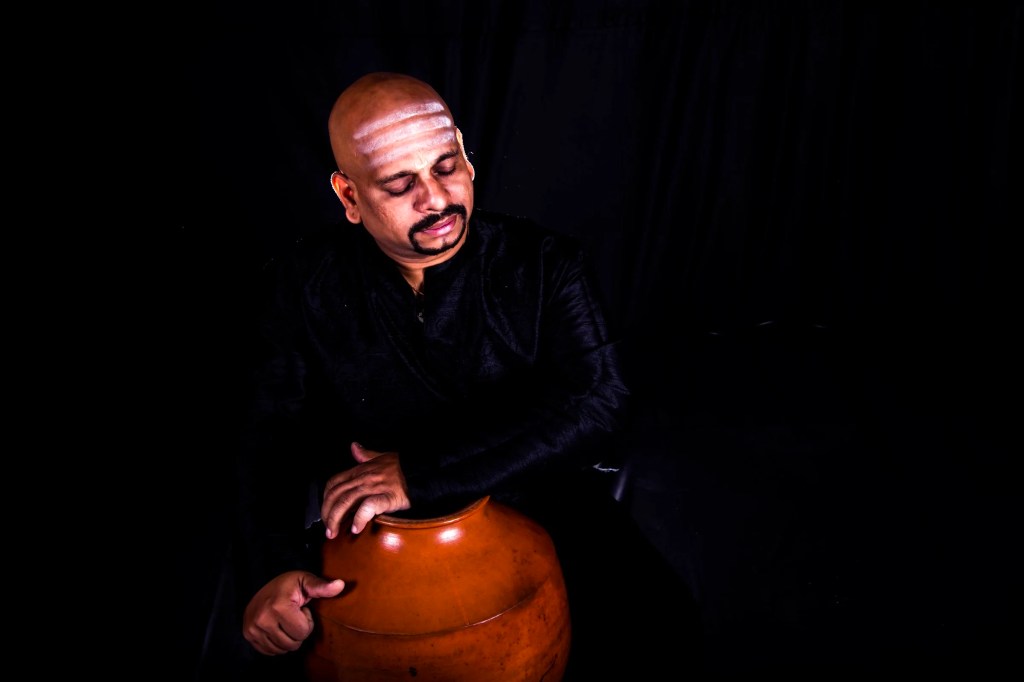
Our guest for this episode is Dr. Suresh Vaidyanathan, who is widely recognized as Ghatam Suresh. He is an extraordinary Carnatic Indian classical percussionist renowned for his mastery of the ancient Ghatam, a clay pot with distinctive resonant and percussive qualities. This instrument plays a pivotal role in Carnatic music as accompaniment and soloist. With a global presence as a leader and collaborator with world-class musicians, Dr. Vaidyanathan brings a unique perspective to the intersection of improvisation and musical expertise. Beyond his exceptional musical talents, Ghatam Suresh is a remarkable teacher known for his creativity and generosity as an exponent of rhythmic knowledge. He is also a scholar and recently completed his doctoral studies on the history of the Ghatam and its performance traditions! Dr. Vaidyanathan imparts invaluable insights into developing musical expertise through improvisation in this first installment of our enlightening conversation. He shares how his intellectual pursuits have enriched his musicianship and unveils his secrets to maintaining and nurturing the quality of mind required to excel in the world of music and the responsibility musicians hold to themselves and their audience. Join us as we delve into the fascinating world of Dr. Ghatam Suresh Vaidyanathan—a musician, scholar, and delightful person.
The audio for this episode was edited by Zeyn Mroueh.
Unedited transcript from Otter.ai:
Bradley Vines 0:00 Greetings and welcome to the neuroscience of improvisation
Louis Kahn 0:13 how accidentally are influenced by circumstance?
Joseph Goldstein 0:41 Africa as fate or karma or accident or whatever the conditions may be happened, they sent me to Thailand.
Bradley Vines 0:51 Our guest for this episode is Dr. Suresh Vijay Nathon. He is widely recognized as Gautam Suresh. He’s an extraordinary Carnatic Indian classical percussionist renowned for his mastery of the ancient Gautam, a clay pot with distinctive, resonant and percussive qualities.
This instrument plays a pivotal role in Carnatic music, both as accompaniment and soloist. With a global presence as a leader and collaborator with world class musicians. Dr. Vijayan often brings a unique perspective to the intersection of improvisation and musical expertise.
Beyond his exceptional musical talents, Gautam Suresh is a remarkable teacher known for his creativity and generosity as an exponent of rhythmic knowledge. He is also a scholar, and recently completed his doctoral studies on the history of the Gautam and its performance traditions. In this first installment of our enlightening conversation, Dr. viden often imparts invaluable insights into the development of musical expertise. Through the art of improvisation, he shares how his intellectual pursuits have enriched his musicianship, and he unveils his secrets to maintaining and nurturing the quality of mind required to excel in the world of music, and the responsibility that musicians hold to both themselves and their audience. Join us as we delve into the fascinating world of Dr. Gautam Suresh Vijayan, often a musician, scholar, and delightful human being. It’s just absolutely amazing to have you here to talk with you and learn from you about your experience and also your background in Carnatic music, can you just say a little bit about your background and just who you are and how you describe yourself these days,
Dr. Suresh Vaidyanathan 3:11 I come from a music loving family background, my maternal grandparents were you know, good musicians, but non performing in public. So, they initiated every child that is born in the family into music, this is when they wanted them to be singing. You know, there are many occasions in the family, where the children as they grow, they are being put into demonstate demonstrating their musical skills. So, also it is being considered as custom and ritual to have the children be taught some music. Because in future, they might, you know, find relaxation, or distressing thing with music. So music was not intended to be a professional families like ours, but it happened. So me and my elder brother, were put into learning percussion instrument from a teacher who was a friend of my grandfather, because my grandfather realized that we show more interest in percussion, or mean kind of beating on whatever utensil or a table or a chair that comes by, you know, so as far as that is handy, we were trying to express our skills. So we were put into this teacher and as we were learning, we started showing more interest in perfecting the art or probably to outdo the equals students that was that is how the entire starts. In fact, the topic is improvisation. So on improvisation is also a way of expressing your one openness, in comparison with your co students made basically, you don’t even study the rules properly, but still, even ahead of that, even before that, you’re into comparing and competing. So, that level, you know, establishes or assures that you are going to go further exploring music, then there was we could win Icron, who was the son of my first teacher, Haryana Sharma, who was busy with Shakti bye band and in every break of the tour, you would come back and you know, supervise the students. On one such occasion he found me to be worthy enough to be taught get him tactic, because I was trying to answer the question as well, then he asked me to attend specialty classes early in the mornings, then will teach me the proper fingering technique of cutter. Again, that is a stage where he would properly guide me into stage by stage, you know, exploration and improvisations, it’s this he first introduced the world to me, you cannot be static, you need to be dynamic. So, to show dynamism, you should do always make a statement and improve on it, improve on it go on improving on it and then so, that was a discipline taught basically, you need to do this. And since the teacher tells you whether it is natural or a trust of one idea, you work on it more and more. So that is how we the next stage comes, then we could become more busy. And then I had to be sent to another teacher, my father to be to the living legend Dr. Devi Gopalakrishnan, who is an expert in Madang. Suddenly, percussion and many music instruments vocal Hindustani and kinetic multifaceted genius. So this man found me worthy enough to be taught, or be put into another galaxy of music where you become a creative musician, you are able to compose you’re able to arrange and organize and lead an ensemble. And also do is particularly appreciate the lyrical part of the music or the melodic part of music because as percussion students, you know, you’re not into learning more of the melodic side of music. Say for example, the raga Audra the progress canes are how they get improved out, they get developed, how you present them the most, you will probably get to learn how to accompany songs, songs are in a restricted lyrical words based on a particular raga. But you need to learn that you need to go with a song you cannot do as a parallel track. You have to embellish any for that reason. You need to learn the song kind of you know, by by experience by it’s not being it’s not taught on a systematic manner. But the teacher always refers to the song you have to do this at this point. And don’t do this in the other song kind of cadence. So that was the next stage then for a long period I was with chemical biology. So learning the process of composing and creating opera kind of music, allotting sections to many other co artists. So this is the next level of learning. So as I was growing up, I was also being put into a company. Some of the greatest percussion players in all colors, and instrumental players. Some of the names I had played with or press Balaton those winner which was Lalgudi, Gera, Emma’s Gopalakrishnan, color, internationally acclaimed kinetic musicians. And on the vocal also, I had been playing right from the doyen of kinetic music, some of what he seen was a Yeah. Who would have been Harlan, particularly years now. If he’s alive, so that is that kind of age difference was there but still, as a young boy was put into a company, most of the musicians so it’s like every concert is an experience. And you play with a big local musician, or an instrumentalist. Both are entirely different in approach in a way in, though both of them present a lot of lyrical compositions because kradic music is based upon lyrical compositions and a large number. But approaching an accompanying vocal music is different from each Music are the skills you know, you get to learn as you grow as you perform a concert. And every concert is a teaching platform learning platform for you. So this is how I started, and almost about four decades have gone by, since I started performing onstage. And I was also good in academics, I was at a schooling, I went to college, in my bachelor’s degree in commerce and masters. And then about 1015 years back, someone suggested this homology courses are introduced in University of Madras, where you can do a mock, get a master’s degree on that. So I joined that course, well, after establishing as a professional musician, but still I treated myself as a students and attended the classes in winter to the library, exploring books, things like that, doing projects, and that is when probably the, you know, the, it dawned on my mind that I should go further deep into doing some research, because I’m being hailed as a very complete percussionist, and someone who has gone deep into the style playing techniques, and the history of meeting some kind of convention and respectability, among carrying some prospectivity on the instrument. This is, I mean, this is another part of analyzing my music, let me first complete this part. So the way the society is looking at me, as a responsible percussionist someone who can give a dignified presentation, I mean, these are all jargons, I would say, but still, they always attach this objectives to someone who’s really you know, acceptable in the field. So, at that point, I thought that let me put my mind into, you know, to go further into research, and interestingly, I found that nobody has done it earlier. One reason is that, there are a lot of, you know, academic requirements, basic conditions, like you should be a master, you should have a master’s degree you should be in a musically connected, and there is a lot of return work that is needed to be done. And when you are expected to do some real research, that is the basic requirement, though some people skip it, and they took, they take other routes, but basically, I’m someone who’s, who was crucial, a lot of interest in reading, and trying to learn, wherever there is a source and retain it and use it, it’s not just music, anything connected with music and information, I normally collect and retain it or you know, try to
put it together to use in my works. So, from there, the journey further went into, you know, referring a lot of books and collecting information about musicians of the past, especially those who played about three centuries back. And then how I mean, what, what I mean the styles of performance and various approaches to music, how they procure, determine how their instruments were made. And then interestingly, when you check the, the Scriptures, the old poem live, works, and whatever works, little literary works that are, that have a connection with music. Interestingly, there’s loads of information about general music musicians, and very less about guitar players. But, when I explored further, not not confining myself to kratom, I mean for to to Carnatic music or music, get up as a pot, you know, it has a lot of other connections, it is a household instrument, it is used in all the rituals not just by the Indian community, but by the entire world. A clay board has been a part and parcel of everybody’s life system. And then, there have been philosophers in all beliefs, who have you know, taken DisplayPort for referring, I mean for describing philosophical thoughts. So, the, the mortality of men, man or remote and the market, maturity of the soul, all these things you know, like this, for every description or explanation they have always taken the clipboard as to to show as an instant instance, or, or an example. So, I found that there’s a lot of material in that approach as well, and started collecting information on that, and made it a part of my research, though it doesn’t speak much about music. But a clay pot also has a different phase, unlike the other music instruments. So the all these things put together, I did my research, I started doing it in 2016. And it took about six years, maybe I should I should not have completed, I wanted to do a little more about time constraints where they’re imposed by the education system. So I had to stop at a particular point, and then put them together, do my dissertation and then successfully have completed my doctorate. But the day I said I should stop, I realized that that was the beginning, actually, honestly, there is so much more to learn about the clipboard and how the clipboard has been mainly to different kinds of instruments. And now there are musicians as well, I mean, living around me who do not play the guitar bass have gotten but as another instrument, the amount of animals high on top, and then convert it into a different instrument, but still it is a clay pot base like this, there are a number of instruments available all over the all over India. And there are of course, instruments like guru or other clay based instruments around the world. So the exploration cannot stop. And I just gave it a temporary break only. So I would like to explore more, if God gives me the stent, you know, life and then the opportunity to do it. But in performance, to put everything in a nutshell, all these 40 years of my journey in music, what I have realized is that I’m not here just to be another compliment in a concept as a fourth or fifth percussion player and go along with the music just moving. And then, you know, having fun with compositions, get paid, go home, have a very happy life. And then that’s it, I mean, put a full stop somewhere, during my journey, maybe three tickets back, I would have I have realized that I am a little different in my performance, I do not know how that realization came. But I have been performing but incumbent more Easter declare a call. But I cannot make that statement because it’s someone else who has to say that, but I’m trying to restrict myself not to, you know, bring in mediocrity and not to bring in an at least spoil being a spoilsport in a in a, in a very smooth, aesthetically developed performance. So my role I started redefining as a better compliment, I compared myself with somebody else who is intruding too much or who’s playing all the time, not to bother about squeezes not giving time to take in the song or allow the other performer to come out with his ideas. These are all I have always been thinking that they you know, they are actually they do not allow an artist to grow further. The the attitude, the sex in an artist’s mind, either it is indifference, or it is you know, high headedness, too much of pride or kind of all the time needing to have public attention, attention seeking attitude, all these you know, restrict a musician to open up or explore further internally. So it’s internalizing, that is what was you know, I was feeling that need to be explored more, which I have started doing and my performance improved differently, because I can see some phenomenal musicians you know, start respecting me start may not be giving me more opportunities, but they always looked upon me my statements my performance, and they underline that this is a class apart. This has happened, you know, all these all these years. I thought that well if someone pays me to be a different a concept or an offer had been standing in either place, I would like to read in that place first. And then if possible to go further up in their expectation, or in public opinion, that is probably the right recognition, you know, someone’s giving you an award or giving you more opportunities, you know, that can come or not, may not be even, you know, striking at the right time, the right proportion. But you are still, you know, given this, this platform or an innovation, that, that gives you a lot of self esteem. So, all these years, I’ve been doing that, getting a lot of students who realize my value, and be disciplined to learn from me, that is one of the point and my performances, I make sure that they have a mark of the most, I would not say sophisticated, but it has a class, it has an authority, a dignity, and aesthetic sense, and realizing the value of an audience.
Bradley Vines 21:17 Amazing. That’s fantastic background and so wonderful to hear how you are approaching development, even when you are so accomplished. And that really is the mark of the the ultimate potential of a musician or someone in any walk of life or endeavor, always striving further and finding those next steps. Even when you play in such a complete way, a way that is so on spiring already so hard. So I’d be really curious to hear a little bit more about how you found that next gear that next level for yourself. Because it would be very easy just to say like you said, you know, I’m doing very well. Look, lots of people love my playing. I don’t know, my calendar is filled with opportunities to play, how did you find that focus? And then what can you talk a little bit more about? How you you found a way to work on getting even better and and kind of what that that next approach was for you that which is a creative leap forward?
Dr. Suresh Vaidyanathan 22:45 Yes, fortunately, I was asked when I reached when I started learning from my third guru, Octavia Gopalakrishnan, he has been performing vocal music a lot. So whenever he had a performs, he wanted me to accompany him and cut him a small boy of like 1314 years old, but the other compliments would be someone who is in his 50s or, you know, a little more very established, celebrated Madonna player or a violinist. So every concert I’m here the smallest and the most inexperienced guy sitting and just for the sake of being TV stars, students, and but the rest of them are all great musicians. But that was the biggest opportunity I got because every concert I was sitting next to these giants you know, listening to them listening to their live music. And it they were literally teaching me how to earn what is the best way of performing they were giving me lessons indirectly by accompanying to accompany my teachers music and performing a very grand solo things like so, initially, they will not even turn towards my side and you know, do a nod or a smile, they will not care even to talk to my side. But I thought that maybe I should recuse myself more to turn their attention, I did not feel insulted. So then on, I mean, simultaneous I was also attracted to the way they you know, present their compositions, their own creative ideas, the groovy, the poetic ideas, and the way they give punches to the accent to their music and they connect with the audience and the sustain that energy and you know, suddenly grow up like, no big gene. So these are all, you know, a big level Seems to me so I thought maybe I should work on this. By start those days, there was no, you know, you cannot record or you don’t have a reference of what’s happened, what has happened earlier. So suddenly, you have to put all your focus on these machines performance. And I thought maybe something similar to what they do, or at least try to learn and repeat. next concert, if he plays the same thing, I will be back by playing the same stuff immediately, so that he’s surprised. So the initial idea was to surprise them. And then I started playing exactly what they were doing. And for more information, the workplane on the MME cannot be exactly played on the bottom, you won’t be able to produce same effect. So I need to alter the fingering techniques, and the concept, and then try to add a little more of my facility on the instrument and show it. So first, this, they were surprised, oh, my God, this guy, this boy is able to grasp and playback, but it was not instant it I had already been working on it from because not every other day, you play with the same great percussion player. So what I do was, what I’ve been doing was to learn this myself or I had a couple of, you know, senior students of these machines, I would consult them very, I mean, genuinely, with all respect, have learned this from them, and then be ready for the next opportunity. So it was a slow process, but I could, at some point of time, I was able to impress upon them, that I’m here, who can, you know, reply to you in the, in the level you expect someone. So this was happening right after one percussionist after another. And at one point, they started that they want to challenge me. So that is my success, when they thought from from a total ignorance or ignoring stature State, I was now being recognized, now I’m being challenged. So then the I started working on that as well again. So if they say three plus four is seven, I would say focus to the side, or at least one plus three plus four is seven, plus two plus four is seven. So it’s one double of one, and then develop to so kind of this kind of concepts. When you reply in there, you know, again, you challenge the back, kind of, not really. But I try to do that, then they come up with some more ideas. And then the best thing is that they start recommending you for more concerts. Till then it was not if you’re there, okay, fine. And then they start recommending your name. So that’s the next level of your acceptance. And once the acceptance starts more responsibility sensitive. So from then on, I thought that, well, if I have to be accepted by these people, I have to stay they’re still there in my thought process, in my work in my compositions, in my rendering, in my brevity, in my accepting and going in the same lights, there are a lot of things that make them happy. And there are a lot of things that make them unhappy as well. So I should avoid those unhappy moments. Definitely. If you’re too long, they don’t like if you play too, I mean, for I mean, the same proportion of their time, they don’t. There’s too much of pride or selfishness that sets in the musician’s mind once he is getting recognized. So he thinks that he should command the next person. I mean, incidentally, the khatam is not the main percussion necrotic music concert. So you have to be submissive, not really submissive, but you know, rested to in your playing, and you know, wait for, especially when the blade is a senior, but that rule has compensating so awkwardly, that even a junior Brazilian player would look upon someone like me? Well, I’m today I do not want to share with you what I play. I will challenge you with the some complex and delicacy. With all your experience, you’re able to respond to be all you fumble, kind of just attitude is there. But I should be prepared for anything if I’m really a professional one. I will charge whatever fees I want but I should be in a performing 100% to my ability and my experience. So you constantly I would have been put into tests. I haven’t put into no challenges that were feeding into my mind reading my brain a lot more work. They were extracting from me a lot of work. I was he even today I keep enjoying them the moment some buddy says that I have composed a new and also copyrighted music. Would you like to I mean, I would like to perform this, I don’t have to share with you, when you have it your experience at all. You can directly I mean, you, it’s all cakewalk for you, as I immediately will say no, it’s not like that, please send me the music, I’ll learn, I’ll be prepared. It’s not just learning I would do I would be prepared with the more of challenging back ideas, concepts to surprise him, not to bother him, but to you know, add my elements wherever that is possible. And tell him that, well, I am a little bit, you know, experienced and creative too. I appreciate your music at the same time, I do have some something to add up or add to it. So this is maybe I mean, I’m not sure if this is the only way a musician should grow. But to me, I find that this is the right way more than, you know, doing a PR and trying to sell my music. I mean, spend more time in communicating, marketing my music, I have always been feeling that, well, I should keep the stock ready. Once I mean there is a particular circle where they know that there’s some quality material that is available. This musician this man can deliver some of the brilliant performance or ideas or the most, you know, I mean, how do you describe satisfaction in music, and you go and enjoy music, okay, if you see enjoyment in music, that’s not the right term, but I still call it so someone comes to your concert and you make him feel very happy, elated or you know he feels satisfied, no some some way you touch is soul on his mind with your superlative performance. So, once you get into that level, you want to I feel that I should remain that once that is not possible. One one when I realized that that is not physically possible, or my mind is not going into it. Or I become more and more due to some reason and maybe contentedness or frustration, whatever it is, if I’m going to be pushed away from this state, I should stop the
Bradley Vines 32:45 keeping the purity. Keeping out mediocrity as you put it is so core to your approach and so important. And the thing about that is to stay fresh, it’s the constant movement. And you do that by constantly challenging yourself and the people you’re with which is very inspiring. So thank you for sharing that. I think that’s so eye opening, to hear that from the perspective of someone like yourself, how you approach each and every concert each and every opportunity as a growth opportunity
Dr. Suresh Vaidyanathan 33:25 as a single seven simple statement. I would say it’s the people around me who you know, made sure that I grew up. It’s not their intention, but indirectly they might be you know, grow into a better musician. By setting standards
Bradley Vines 33:42 now you are playing that role in so many young musician well musicians of all ages that come to you to learn and we’re helping them to raise their level and find the path to the next step in their progression. The legacy continues of your teachers through your teaching of your pupils.
This is an interview with the incomparable Kenny Werner. He is an improvising pianist and author whose impact on the philosophy and practice of improvisation has been extraordinary. In the realm of music, Kenny Werner’s improvisations weave melodies and harmonies that are rooted in but not limited to the jazz tradition. His groundbreaking work as the architect of “Effortless Mastery,” a transformative methodology for nurturing musical talent, has facilitated the growth of countless aspiring artists worldwide. What sets Kenny Werner apart is not only his technical fluency as a performing artist, but his understanding of the deeper connections between music, self-discovery, and indeed life itself. Immersed in the teachings of Indian philosophy and their echoes in Western thought, Kenny brings a unique perspective that extends well beyond just music practice. This discussion delves into the very heart of Effortless Mastery as Kenny opens the door to a world of possibilities through guided exercises, allowing you to experience the essence of his approach firsthand. Throughout the discussion, Kenny plays the piano to demonstrate, and you might even witness the creation of a new composition! Whether you’re a seasoned musician, an aspiring artist, or simply someone with an ear for beauty, this interview with Kenny Werner promises to be an unforgettable exploration of the philosophy, music, and wisdom that shape his remarkable journey.
Bradley Vines 0:00 Greetings all and welcome to the neuroscience of improvisation. Get ready to embark on a journey into the world of improvisation with a master of the art form. Today we are honored to host the incomparable Kenny Werner and improvising pianist and author who has impact on the philosophy and practice of improvisation has been nothing less than extraordinary. In the realm of music, Kenny Warner’s improvisations weave melodies and harmonies that are rooted in but not limited to the jazz tradition. Kenny’s groundbreaking work as the architect of effortless mastery, a transformative methodology for nurturing musical talent has facilitated the growth of countless aspiring artists worldwide. What sets Kenny Werner apart is not just his technical fluency as a performing artist, but his understanding of the deeper connections between music, self discovery, and indeed life itself. Immersed in the teachings of Indian philosophy and their echoes in Western thought, Kenny brings a unique perspective that extends well beyond just music practice. This episode delves into the very heart of effortless mastery, as Kenny opens the door to a world of possibilities through guided exercises, allowing you to experience the essence of his approach firsthand. Throughout the discussion, Kenny plays the piano to demonstrate, and you might even witness the creation of a new composition. So whether you are a seasoned musician and aspiring artist, or simply someone with an ear for beauty, this interview with Kenny Werner promises to be an unforgettable exploration of the philosophy, music and wisdom that shape his remarkable journey. Let’s begin.
Sister Wendy 2:13 Science Advances one step leads to another autism is about being human.
Swami Sarvapriyananda 2:36 The people who are pioneers in these systems, the Buddha or you know Adi Shankar are going to be the Christians, they would be very interested in development.
Bradley Vines 2:45 This is great, what a pleasure. Thanks for joining us here. My goodness, we’ve got Kenny Werner in the house. This is This is amazing. Much appreciated. And you are, of course, tremendously well known for your effortless mastery methodology first came out in the 90s, I believe, and of course, yes, you in I think 2021 or so you came out with becoming becoming the instrument? Yes. A wonderful addition,
Kenny Werner 3:23 one would think one would actually think I’m an author.
Bradley Vines 3:27 Yes, one would given the communication style and fluency and also, the fact of having two books. Now, beyond that you, you, you have, of course, your effortless mastery Institute at Berklee College of Music, where you’re taking these ideas forward. And now an online course that you’re actually currently running.
Kenny Werner 3:52 Well, we’ve done that for a couple years. But this first time I’ve done a course for the second time. It’s the I have two courses. At Berkeley. One is effortless mastery. One was effortless mastery. Two, the four steps in effortless mastery are the answer to the whole book. So people enjoy the first part of the book, when they say, How did he know I do that, you know, that’s their neurology, right. However, the four steps are reprogramming steps. And when Roger Brown gave me the platform to teach them as semesters. That’s quite a challenge. So the first two steps are the first semester because you don’t change that neurology. And that’s why I’m excited that we’re talking because I have a few questions for you as well. It’s time to translate this completely in terms of neuroscience, because it completely translates. So the first course is just the first two steps. Go if you don’t establish a baseline of neurology, that precept As a music is not nearly as important, as the previous neurology posits, because if understanding music’s importance made you play better, then we would take courses in enhancing its importance in our minds. But most people would say the opposite, the more important music is, the less important I seem. So the neurology just like, if you like Italian food, you smell meatballs cooking, the neurology is let’s get at it. If I say let’s play, the neurology might be, oh, now what? This trepidation over something that should be at least as enjoyable as meatballs. And that’s why it’s older allergy. So anyway, the course we’re doing online, now, we only did the first one. So if somebody wants to still sign up, they can. Because as a roll record, it is just focusing on first two steps, which is a neurological reboot. It is take the analogy, like it’s changing the polarity. Or it’s changing the apps I like to think of as changing the software, I mean, changing the operating system. Because if you have an operating system that values music over yourself, then the apps of liberation can never run on an operating system. So I like all three analogies. It’s an app, yeah, but let’s say you have a new app, the first two steps of effortless mastery have liberated you when you can’t do it, because the operating system devalues you in the face of music. So those apps don’t run on that. However, if we take and it’s worth taking that much time, at Berkeley, we take a semester. Now people can do it the me online because not everybody is going to move to Boston and spend this god awful mount of money. Just saying get to my course it just doesn’t make any sense. So now we do it directly. And expensive though it may be it’s so much less than going to Berkeley. So but here’s the thing, we reprogram the mind to distract yourself from the importance so that the body can experience the instrument. So effortless mastery has grown because it used to be accidentally someone asked me to give them a lesson. I said right there, you just got in your own way, right? There’s a 9080 something. Someone said, right there you care, then yoga. Yeah, right there. How’d you know? I said, Well, I don’t know. I hadn’t didn’t really think about it. But besides you look different when you care. You also played worse at the moment you cared. So then I made up these exercises. How do you not care. And I would start to use stuff I was learning about in the 80s. You know, the whole holistic thing kind of unfolded in the 80s. The 60s was the discovery of love. But since it was drug fueled, it had to be temporary. replaced by the 70s, which was just going after the high. Whatever the point was originally that was lost in the 60s, that and a few assassinations that, you know, disillusion you from what country you thought you were living in, right? Plus drugs. It was a statement. I’m going to redefine love. I’m not going to love neurologically the way my parents did. Because there was an awful lot of shallowness in that. I’m going to rediscover it I’m going to take this pill was the right idea. And the research on that pills, which I’m sure you’re well aware of, was cut off when Timothy Leary made it into a protest a countercultural thing. That was enough to shut it down and make it
Kenny Werner 9:08 right. All that research was over, as you know, probably it’s starting to pick up again in the 90s. And it’s pretty much in full force. Now. The part that validates effortless mastery is whether with a question to me, I knew that psychedelics could change your neurology instantly. I just assumed that the change would change back within a day or two, because it always did. Now that movie, how to change your mind and the book actually, which I’m sure you’re aware of the people’s stories, they talk about losing anxiety for good. They talked about not being depressed ever again. They talk about you know, so I want to know what’s going on with the psychedelics that my last turn with it was in the 70s and the problem with it, it was complete but it was temporary where Right. However, what he points out is neurological pathways. And I learned that actually, a long time ago, I took a course, me and Mark Johnson, this great bass player, but it was this guy, Robert Fripp or something like that. And he wrote a book called the path of least resistance. And it did. Now, the idea that of neurological pathways, which I never forgot. But the more I taught effortless mastery, the more it took it away from the romantic like music, it took it away from the spiritual like, it took it away from the philosophical which is just like pablum to the neurological. Because today, if you’re having a revelation, we don’t know if there’s a God fueling it. But we do know that you couldn’t see it if you measure the if you put some gizmos on the brain. So the only thing we’re sure of is that this existence is extremely covered, colored by various neurological pathways. And effortless mastery is aligning itself with that more and more, I’m not doing anything, it everless Master, if you don’t try to create a path, then you follow it. And that’s how this whole thing has grown. Which is why I was interested to meet with you because I need to get with neuroscience now. Or a neuroscientist that understands everything except the last thing they understand, which is the experience. They understand the technology. They may even be a bridge for others. But they’re not themselves having that experience. And effortless mastery is that piece of the puzzle. And I think they might fit very nicely together more information for me to validate what I know, transferring, you need to know that it’s far less difficult to do than anyone imagines. So now I have a question for you before we start, when I tried to describe to musicians, the neurology has to be changed. Because look, if I say where’s my metronome, trust your metronome. vise, this is the fourth step and effortless mastery. The first step first few steps is what everybody’s interested in. How do I change my self judgment, which then, of course, takes us out of the bay of music into the ocean of life, if we can only change the neurological predisposition to self judge, right. But once you have achieved that, that’s what the first two steps do. It takes a lot of losing it and finding it losing but the programming is based on repetition. Without repetition, there is no programming. And so the fourth step, now that you’re not confused anymore, that you have nothing to do with this music. And you’ve been practicing the first two steps long enough, so that even though you’re not always there, you can get there, it’s more like a fork in the road. Now I can go down the old path of thinking this matters. Or you take the right fork and watch myself breathe. And I will demonstrate to you step zero while we’re together. But have you done that already to train the machine, the instrument that plays the instrument, you can never train the instrument because you had too much neurology attaching meaning that was illusionary or as they say in Sanskrit, Maya, the illusion ego, we could go to the scriptures for we could go to the psychological studies, when you go to neuroscience, it’s time to use it. Okay, so let’s say you’ve gotten out the illusion that what you’re doing is important. And boy, once it’s not, you find out something you can never find out otherwise, every note works and relativity to every other note. The theory of relativity is just a term I only came up with two days ago, because this shit is still writing itself through me. Very well relativity exist. If I play this note, there’s no choice that wouldn’t be inspired. Next, not when the mindset is been fixed. And that’s steps one and two. But assuming they’ve been fixed, you can talk about liberation all the time. If there’s no exercise, there’s no change. If there’s no repetition of the exercise, there’s no change. It doesn’t matter It doesn’t come at all if your exercises are fuzzy on a philosophical or spiritual level. And it doesn’t come if you have exactly the right exercise. But ego keeps you from repeating it. Without repetition, there’s no reprogramming until they get to know the technology, right? Look, let’s say you find a color in the brain. That’s doubt. Now, that’s why psychotherapy has changed. It’s much more about triggers. Right? We have a lot of examples where you and I offline, can look at all the things that cross check this. But when they get to technology, right, you got your mouse in your hand. Oh, look, it’s a dark purple with brown. That’s doubt. Okay, do me a favor, grab that now press Delete. I think someday they’re going to do it. And an awful lot of hybrid instrument industries are going to collapse. If you thought you needed God, for example, to erase doubt, or you thought you needed a church, or you thought you needed psychology, or you even thought you the, you know, the music. Disconnect music from the value of the human being. And now you have the possibility of playing it, playing with it. So let’s say you’re on the fourth step, you’ve already gotten over yourself, right? It’s another way of saying it. Now, you hear that? If I say neurologically is transparent to me where one is? I don’t have to think I’m a master. Everybody always asked me, How can I repeat the mantra I am a master? Well, we can find something like walking or using a fork. And if you’re from parts of Asia, using chopsticks, now they take that for granted. Not me, I’m sitting there trying to get up three grains of I have to push them together to drag a piece of chicken out of the frickin ramen. Okay, so it’s all relative to the neurology. So let’s say my neurology says even like faster
now my question to you is, when the neuron when the neurology is transparent, like walking, you don’t have to think about the neurology of walking. There’s also very little if any ego in walking, you don’t think, well, Monk would walk this way. Some people actually do. But you know what I mean, generally, we walk to the bodega down the street, we don’t really give it a lot of thought. So a neurological certainty, causes a physiological mastery. You don’t do to left foot, it’s left, right, left, right, without thinking, one serves the other. And it happens by itself. First of all, music can be learned on that level. And then you see the miracle you see in some people’s playing. I like to play people and explain to them that way. And then they go, Oh, it’s not just this vague thing that people either have or they don’t talent. No, it’s all neurology. If you’re patient enough, this is my question. When the neurology is so transparent, that the physiology is automatic, what do you call that? I called it neurological physiology. And I gotta believe there’s a better term than that.
Bradley Vines 18:32 That’s a good way to put it. I mean, there are a couple of terms that come to mind and, and maybe taking a step back. As I’ve been delving deeper and deeper into the neuroscience of improvisation and music more generally, I see many an insight that aligns with what you knew, and have been refining your communication of so many decades ago, and and into the present and future. So
Kenny Werner 19:03 let’s say you’re picking your nose, you want to pick your nose? You don’t accidentally poke yourself in the eye? No. Okay. The neurological awareness of where the nose is, is automatic. I call that a transparency, right? Why does the man go there? What’s the physiology thing that follows? Or all I’m asking you, does complete neurological transparency. The de facto is a physical movement.
Bradley Vines 19:34 There are so many great examples. So physical movement is is definitely ultimately the currency of our embodied presence in the world or experience. If we take let’s say, I think a paradigmatic example is bicycle riding. So doesn’t matter how much I teach you about physics, and the mechanics of that bicycle and what you’re going to do when you take off You’re just going to have to get on the machine and figure it out, the body is going to have to figure it out. And after a certain amount of time with repetition, as you noted as particularly important, it will become a fluid process where your muscles through proprioceptive feedback and so on and aligned with your intentions for where you want to go, you’re going to get a feel for it. Now this is called developing what we would call procedural memory. So I think there’s four,
Kenny Werner 20:35 what was the word? Memory, what’s myelin.
Bradley Vines 20:40 Myelin. Now, myelin. Now this is okay. So the brain, you’ve got the nerve cells, the neurons, and they’ve got a cell body, and then these axons that extend out, and those are, those axons are the means by which they reach towards other neurons and send their signals onward. So myelin is what basically coats the axon, which makes it easier for information to flow. And that speeds up processing basically. So you find that, that neurons that are getting used more, yes, there are certain pathways are going to get reinforced both with the myelin development, but also the development of dendrites, which are kind of the antenna I have the next neuron listening is that word? I’m sorry? dendrites? Yeah, there’s there’s a whole there’s a whole physiology involved here. Indeed.
Kenny Werner 21:42 That’s what I’m asking you. Is the neurological transparency, the absolute knowledge in the brain of how to ride a bike? Does that Auto Translate to physical manifestation of
Bradley Vines 21:56 it? It does, indeed. So there is
Kenny Werner 21:59 no neurological physiology. There’s just neurological transparency, because the other thing is already
Bradley Vines 22:06 failed to complete. Exactly, basically, yeah.
Kenny Werner 22:09 So I’ve had this question now for a year,
Bradley Vines 22:12 a very simple way to put it is that whatever you do is increasing the chances of you doing that thing again, in future.
Kenny Werner 22:22 Even though the manifestation is physical, neurological Transparency means I look at a map and I can see what is new North America and South America that’s neurologically transparent. But it’s only within the realm of mental transparency, mental recognition, I’m calling it the dawn of recognition, right? But I couldn’t explain and now you’re telling me, they are bonded. That’s why there isn’t exactly a word, unless you want to go with about five or six syllables. You know, look, if I do this
that’s effortless mastery. But so it’s this. People asked me, How can you give me a meditation that says, I am a master, because you are a master. And now I’m realizing this is already benefiting me that we’re talking. Complete neurological transparency makes you a master of a physical action, because it is done perfectly every time without thought. And that’s why, if we set the neurology first, instead of practicing with this neurology, I’m unworthy. Which is where most people get to, if they didn’t start, nobody started that way. It was either parents, or their first teacher, or a restrictive public school environment or something in the society taught us to care. After the first experience, which if you look at children touch the instrument, is the truth.
Kenny Werner 24:24 That’s the truth. Everything after that is a permutation of ego. Which is to say, How am I doing? The one question that limits musicians in their quest to get better, or musicians in their quest to enjoy playing? And now effortless mastery is not just about music anymore. The one sentence that gets in the way, how am I doing? So the surge, elimination of that question, so that even when it does pop up in in neurology, your first instinct is, oh, let me focus on something else, because that’s the last question I ever want to think about again. How many times have you ever asked yourself, how am I doing? Did your day get better? And it always got worse. So I’m going to show you step zero right now, if I may. Now, please. Now this is where we borrow from yoga, we’re borrowing from the Vedas. We’re borrowing from the Mahabharata, from the Bhagavad Gita. When Krishna comes, and he ministers to our juniors, he’s about to go into battle. This battle has a whole representative, it’s all about the mind and the ego and the spirit, but it’s represented as a battle of royal families. So a basic thing of I don’t like saying Hinduism, because it is Hinduism. But that’s also the religion, which is always a structure that obscures the spiritual heart of the religion, right? But the Vedas, Vedanta is very, is that the Bhagavad Gita is, I don’t know, 700 verses on detachment, do your dharma, dharma is the action you are meant to do. This whole thing is a play, and you’re playing your part. Don’t do it. Watch it being done. Now that is not original, that goes back to the earliest scripture of metaphysical scriptures to be the witness. That was even the name of it, the witness consciousness. So
Kenny Werner 26:43 if I witness, the piano being played, well changes in neurology quite a bit. So it’s not my responsibility, you could simulate it by watching someone else move their hands on the piano.
And notice that you’re not involved at all. Because in your mind, you’re watching someone else play, they play too good, you might have a little bit of attack of self esteem. Which is why listening has been ruined for musicians, because of the urge to judge themselves against what they’re listening. However, if you’re if you’re not, if you’re blessed to not be a musician, then you just look oh, look, his hands are moving. And I feel in no way responsible for where they’re going. The neurology of the first two steps is to be able to experience that, although it’s you. So it has the neurological component of surgically removing the responsibility. Responsibility when it comes to creativity is a buzzkill. Respect is fine. But right before you’re about to commit the creativity, you need to Divest yourself of all respect for what has ever been. Because that becomes the baggage that you’re trying to play through. How do you create that neurology, the recognition that no one has ever pressed this button before me. And then you’re noticing something now, aren’t you, Bradley, that there’s not one note, that doesn’t go as if the universe ordained it with the previous note, without exception. But what allows this to happen is a mindset. And a mindset is a polite term for neurological transparency, which is a term I made up earlier today. Maybe it exists in the science. That’s why you and I can probably have some, some add to the body of work. But the thing is not to add to the body of work, but add to the body of people that can experience it. Let’s get more people out of the delusion and into the truth. The first thing they got to know is it’s so much easier than they imagined. So that transparency, sets up a new polarity or a new software. And by this way, I think you’ll appreciate this as a neuroscientist. Now we don’t limited to people that are musicians. There’s two instruments that you can easily practice this neurology, drums and piano. You don’t have to know anything about the piano to play the notes saxophone, you get hung up on, well does armature violin, you could really do it. But because if you understand that this arm does this, and this hand does that, actually, you can do it. But it’s a lot more pleasant on the piano, which doesn’t sound much worse than someone who never played it or someone that’s a virtual so so the piano And the drums then become a new therapy for liberating people from and you can use all the psychobabble and all the holist about Well, that’s a word I made up. Holistic language has become as bad ballistic as psychology babble. So there’s a new word. You’ve heard psychobabble, right? Oh, yes. Yes. What is popular, right? A list of Babel. That’s all the language of liberation and none of the experience that you have to look at the person that’s saying, You should love your mistakes. There’s one. That’s good holistic babble right? Meaning, don’t you believe the truth is that you are more precious, and your preciousness is not in any way affected by making mistakes? Don’t you believe that? Of course. But then if you make a mistake, and an instrument will hold a mirror up to you, you’ll realize that even though you believe it, you can’t access that thought at that moment. So the language of freedom is not nearly as important as the experience of freedom. And then the question is, what exercise are we going to do? Because without an exercise that remains holistic Babel, kind of right to a list of Babel. Think goes like like that? Yeah, it’s coming. Luckily, we’re recording. That’s the first four bars and Melissa Babel, could be three and a half, or five and one quarter, I wasn’t really counting. But you see what I mean? Without the barriers, the pseudo the barriers, whoa, get ready for quotation marks, the barriers of pseudo importance. US it belongs to everybody on contact. Wages learn to move your fingers faster. Now having codified that liberation, naturally, the question comes up, how do I do that while playing something real, which is to say a form or in time, or what if you want to be a liberated being and before that? Now, the fourth, the third step is this. First step is this. I’m watching my actually, we need to step zero. This is where every class I’m going to do with you. Okay. All right. We hear that
was a fire truck going by? Huh? Okay, that was God saying? Check this out. Bradley. Okay, ready? Yep. Are you breathing? Your breathing? Right?
Bradley Vines 33:05 Yes.
Kenny Werner 33:06 You don’t have to think about it. It’s not a trick question. You are breathing. Right? Absolutely. Even when you’re not focusing on your breathing, you’re still breathing. Luckily, luckily, your breathing is not dependent on your self esteem. Like other things, like I’m going to give a lecture on neuroscience. And I want it to be good. Now. It’s not gonna be such a great lecture, right? Which is the foundation of effortless mastery. Trying is what gets in the way. hardly unique, but never so well. deprogram, then effortless mastery. Okay. So luckily, you could be in your worst state of mind, you’re still breathing. You could have just had a baby, you’re still breathing. You could have just lost a child. You’re still breathing. You could have had the best gig. I assume you play an instrument to have your life but you’re still breathing. You could have embarrassed yourself in front of 1000 people, you’re still breathing. So breathing, we’re going to use a little differently than all the other holistic models. Breathing happens. Whether you’re spiritually fit or not. Whether you like yourself or not, right. You’re breathing whether you watching it or not, right? Yes. Can you feel approximately where you’re breathing in your body? In the body is a machine. Right in the machine. There’s a gizmo in the machine. It’s somewhere around here, right? You can feel that right. And it breathes it’s like the boiler in the basement. It breathes right? For 20 seconds for a very short time. All I want you to do is watch it. Breathe. Ready go.
Now stop. Now, when you look at this video, you’re gonna see a change in you.
You’ll see it. That’s why I can do these courses online. Now, I’m not gonna explain it yet. Let’s do it again. But remember, don’t translate it into anything more meaningful than exactly what I’m asking you to do. You breathe, right? You are breathing before you are watching. For 20 seconds, find the gizmo in the chest that breathes. And watch it ready, go. Don’t close your eyes, because then you’re conflating it with meditation. Okay, okay, is manifestly unspiritual Let’s stop. Let’s do it again. I’m gonna describe it again. There’s a gizmo in your body and it breathes. Watch it, watch it, breathe, not you. Watch it breathe. For 20 seconds, go. But look at me when I look at you. But we’re not looking at each other. We’re watching ourselves breathe.
Watch it breathe. I mean, really watch it free
you go. And stop. It’s hard to stop when I say stop. But if I said How long can you do it, then you wouldn’t be trying to keep it going and you’d stop. Reverse psychology is a very real thing. Okay, now, did you have an experience? Absolutely. It was the absence of things. There wasn’t a unit you just that was not there before. It was to you that’s always there. But for all these imaginary barriers. So I’ll tell you what is the innovation of this step zero. For one, you don’t say I’m going to watch myself breathe. You remind yourself well, I’m already breathing. So I’m not about to do anything. To you imagine it as something that exists separately from you know what, you’re going to watch it breathe. Three, you’re only going to do it for 20 seconds. Because if I said do it for five minutes, you probably wouldn’t ever get there. But anybody can drop any aspect of their life for 20 seconds. So it disarms the feeling that you’re losing your life because you have to let go for five minutes. For 20 seconds I can let go of anything for when you’re done, you say stop and you don’t even think about it. It’s like it never happened. So you’re introducing something to the mind that you’re not going to clouded up with the imposition of meaning and urge for it to have meaning you would have had to refer back to it to divine its meaning but if you don’t go back to it it never happened. However, there are impressions left and this is the neurology by do it once it’ll be something I can recall wow I can he put me through this trippy little thing. So the next innovation was your stopping when you stop you know go back to watching TV go back to whatever take another bite of a meatball whatever really stop it has to be free of the past or the future. It has to be free of challenge and for do that you have to remember how simple it is finally the less innovation less Do you think my god he’s come up with something so simple. It allows me to change No, you’re not going to change because you will change back very quickly. So after you’re done whatever neurological thought you were thinking about whatever your future how’s your future gonna be? What are the things age appropriate? I don’t know You don’t look like you’re close to retirement yet. We’ll Berkeley up my contract again. It could be that or what about how many people ever come to my masterclass Am I give a thing on neuroscience or whatever you were thinking about questions that have no answers, otherwise known as the future. After you’re done with this exercise, you’re not only don’t try not to do that you invite yourself to go back to your problems. Okay, I watched it brief. I’m done. Now let me go back to obsessing about shit that I have no control over, which is the majority of what hangs up people in this world, especially this world, especially this time. Right? Maybe trying to thank God, I have so many passwords. I gotta buy one of those services that stores your passwords. You know, this world, there’s plenty to lose the presence on. So after you’ve done this exercise for only 20 seconds, but you couldn’t make it half a minute, if that feels better. You give yourself permission to get entangled again. And whatever it was, you were thinking about that step zero, beautiful. Now, here are some of the backups if you want to make it spiritual. You could say this. I’m not breathing. I’m watching it brief. Here’s how it becomes spiritual, a very aligned with whatever the spiritual heart is. Vedanta, whatever. Do you know that Guru? Ramana, Maharshi? And yes, okay, he only had one practice, one practice, right? You don’t have to chant. You don’t have to meditate. You don’t have to do austerities he had one practice, who are you? The teacher I studied with which I don’t say publicly and I’m not supposed to say publicly was a guru taught witness consciousness. So this is a very, very old practice. The science of the mind was available, we’ll just say in the East 1000s of years before the West. And then there was this distraction of religion. That completely took us away from the point of a science. But if you look at the scriptures 500 A D. 1000. BCE, they say Before Common Era now, right? You Oh my God, these cats had it figured this is 15. This is like 2500 years before Freud. You know, I’m saying. So from those sources, whatever you want to call it, the east, I like to say it definitely came out of the east. It expanded to the a different part of the East, Japan, China, Hong Kong, became Buddhism, but Buddhism started in India. I guess it’s Indian, right? Character, Buddhism changed because the character of people from Japan, and the personality was different than the people of personality in India. But whatever the idea of witnessing Rama Ramana Maharshi would say, who are you? So if you were watching it, breathe? Who was watching?
Bradley Vines 43:11 Good question. Very good question. Well, then
Kenny Werner 43:14 it becomes a spiritual issue. Or if you want to talk about superconscious mind, what kind of science is that? Is that neuroscience? Or is that sort of psychology science? You know, conscious mind. self conscious, subconscious, super conscious. What is that science Bradley, I don’t even know.
Bradley Vines 43:32 All of these have a level of description of neuroscience in the realm of neuroscience, okay.
Kenny Werner 43:39 Or you say Universal Consciousness, right, universal consciousness, which is a language that I think comes from when religion systemically, not everybody, and not every pastor and not every church, but when religion and mass started to separate us from ourselves. Another form had to come, and that’s what we call spirituality. How many people today say I’m not religious, but I am spiritual? If you are a religion, the answer is an alarmingly amount of people will say, I don’t belong to a religion, but I am spiritual in that understanding. There’s individual mind, universal mind, that may also be part of, of neuro neuroscience, but the idea is that I have universal consciousness is really borrowing from early Indian metaphysical scripture, I guess I call it India. It started in India so it’s another places to but I’m not a historian. I’m aware of the starts in India right? So in whatever language you mentioned, the tools are exactly the same. And effortless mastery is now a convergence. And now I’m going to really sound like, you know, bring on the influences, I guess, through me. Because I wasn’t looking for it. So that’s how you know it’s authentic. I never thought I want to be something to somebody I want to play, I’ll tell you what most musicians don’t admit, I want to be the best player in the world. And I want everybody in the world to fucking know it. And then I want to be paid millions of dollars to show it. Okay. However, I seem to have a different calling, as well as being pretty up there when it comes to playing. But I have this other calling. And the fact that I wasn’t looking for it, is the best indication of its authenticity. And today, it’s where it is, at this moment, there are still new terminology coming out, like the theory of relativity, that was two days ago, here’s the theory of relativity. They’ll sit knows, because since our facilitator, people aren’t seeing, but he’s my angel these days. This is called the second step. It’s like moving the hand spatially, and not paying attention to the superimposed meaning of the order.
But I just realized, but it’s the theory of relativity, isn’t it? I don’t know what that actually is, as expressed by Einstein, I don’t know what it actually is. But every note is relative to every other note, how could one be more relevant than another? It has to be a delusion, that one note is more relevant to another, not the truth can’t be the truth. The truth is the absence of desire. The truth is the absence of a goal. You have a goal, but you need to put it out of your mind. So you can pursue that goal. Because the oppression of the goal itself is reason enough to ruin this day. How do you remember the day Bradley? Thinking about your future? So it’s very universal? Right? Okay, I’m gonna shut up for a minute, you got something to ask me.
Bradley Vines 47:40 This is wonderful. Food for thought. Thank you for sharing all of this very enlightening. And it’s amazing to experience it in real time with you. So I am sure this, so much will come across to listeners, but it’s a real pleasure. And, and I do just see so many wonderful parallels with well just take, for example, this idea of relativity. It’s something that Roger Shepard who was a leading neuroscientists, cognitive scientists, took into account when he created his model of pitch, pitch, pitch relationships, that involves this helix formation that allows for pitch height, but also tonal qualities of the pitch quality. And also tonal relationships, these ideas of self definitely have parallels in, in the emerging neuroscience and, and also just theoretical understanding of consciousness as a kind of program, like you have said, so something that’s running in the background, just like any other perceptual process, like seeing this,
Kenny Werner 48:55 like CPU, computing power in the computer. Yeah,
Bradley Vines 49:00 it’s a creation of the mind. So you’ve touched on a bunch of things that I wanted to talk about meditation and, and music. It’s psychedelics, to some extent, there’s maybe more to explore there.
Kenny Werner 49:16 Yeah, oh, almost three things. We’ll just take meditation for a second. Let’s do that. Let’s do that. Words that originally indicated liberation become the new prison. If you ask the average person, Let’s meditate. Their first thought was, I can’t do that. Because meditation, the word has gained enough pseudo meaning to obscure the act of zero. If I call it a meditation, you wouldn’t be able to do it again. But if I said, Hey, Bradley, are you breathing? And he said, Yeah. Were you breathing before I asked you that? Yeah. You see where it is? Yeah, watch it. Okay. Now you actually are meditating. But nobody presented it quite that it was that available to people that weren’t quite that lazy. Like me. This is something you’ll find interesting. I always thought of myself as less than because everybody works. So hard music, nobody believes they were asking me last night this party. Of course, she spent four hours a day right now, we got to ask every woman from my wife all the way back to my mother, she recipes I never practiced. I’m not recommending it. But once I embrace the fact that I never practiced, I figured out how to do more change in my playing with 20 minutes than other people when they’re sitting there grinding it out for four hours, which I share, but only at the level of the fourth step. Because if you can’t change the polarity of your mind of caring, you couldn’t do it anyway, even if I showed it to you. Your mind is way wired to not be that simple. Especially around music, which you presume to be of a finer quality than you this general idea of music. So in the same way music has become a word has baggage, meditation has baggage, listening, has baggage. Now you ask any musician, when they listen, they think you ask anybody at Berkeley, especially what is listening me, I have to understand it, or I have to transcribe it. Definitely transcribing is potentially one of the most harmful things you can do. Not for your ear, but for your neurology. Because after you transcribe, you can never listen to anything anymore without being conscious that you’re not transcribing it. Neurology, right. However, you can transcribe, we can’t cover it all in one session, right? But listening means trying to figure out for a musician, listening means comparing yourself to the person you’re listening to. Do you know and a lot of kids if you shy don’t know you’re gonna show this to but people are studying or shake their head? Yes, when I say this, how many people avoid listening, because it challenges them to have a lower opinion of themselves in relation to the person they’re listening to. So therefore, it’d be just better if they didn’t have time to listen today. So I’ve replaced the word listening, which now is corrupted with hearing. Why would you have to listen? Why would I have to listen to this? It’s being played in the same room that I’m in? I’ll hear it. If it’s in the same room, I’m going to hear it why would I have to listen? So at least for now, hearing is a clarification and a relieving of ego as opposed to listening. Listening beckons self judgment. Listening, invites comparisons. Here hearing is just something you do. If something’s making a noise in the same room you’re in, you hear it. Now, will they find a way to put baggage on hearing? I’m sure somebody will. But sometimes you need a term to defang the previous term, listening meditation, God, Oh, my God, what word has been corrupted more than that? So terminology has a way of becoming corrupt. Because So ultimately, look, it’s not about the terminology. It’s not about the technology. I’m saying this for certain person to send me this video. Because this guy’s invented new instruments. He thinks terminology change, technology changes anything it doesn’t. There’s only one thing that changes anything. The mindset of the instrument, the mindset of a human being, we won’t save this planet with new technology. Or it will take a mindset to create it. What we already have it, don’t we? But without a change in mindset. We can’t use it. Right? What a perfect example. I never said that before. And that’s why effortless mastery is still evolving through me. I have a name for it isn’t ism. It’s not Hinduism. It’s not Buddhism. It’s not Christian mysticism, not communism. Capitalism. It’s Long Island Jew ism. Right. Now, why is it Long Island Judaism? Because I’m a Jew, not a practicing Jew from Long Island. And this is coming out of my mouth. It is the tyranny of terminology. Is the delusion that technology is the way and it takes a lazy man are a lazy person, a lazy mammal that covers it right? To find the truth? You know, there’s a saying. Necessity is the mother of invention. Laziness as a mother of invention. I can give me an example of one of the earliest examples, the wheel. Well, how many 1000s of weird years? Were they already moving things and going from place to place? Did they really need the wheel? Or were they tired of walking? So really, laziness is the mother of invention. Now, you know that, if you honor your laziness, you’ll find pathways that lazy people were previously exempt from, because it took work. Cool, right? So this whole thing comes together in some sort of a macro, a quilt of understandings that now can mesh together by allowing for the intuitive spewing of it, rather than the erudition, of studying it. But without an exercise, there is no movement. Now, if you go back to the Vedas, the Mahabharata no the Bhagavad Gita, Krishna is the little blue man. Krishna is blue. Actually, I have a tune
remember it, but you can find it on YouTube. Go Kenny Werner trio, Little Blue Man. It’s about Krishna.
People we know would have great philosophical statements that they would agree with. Right? But here’s the thing that I discovered from my laziness. Here’s your philosophy. But here’s your experience. Why is there a schism between the two? And I can use one of the most blatant examples. Love your mistakes. Don’t you believe that? You might have even taught that. Right? Love your mistakes. But do you? So it’s a very blatant example, when you were making mistakes when i What if I said, Should you love him? And he said, Yes. I’m talking to my friend over here. Okay, so how do you get to the Schism? Here’s the philosophy. That’s what you believe. But this is how you behave. A practice. There has to be a practice. Doesn’t have to be daily, but it has to be repetitive. And see every other day or this morning and Lebanon yesterday, I thought tomorrow, five, and two days didn’t go and you don’t care that you didn’t do it for three days. It’s 12 o’clock. You’re going to do it right now. But you except like brushing your teeth. Here’s the example that I came up with. Okay? If practicing music was like brushing your teeth, everybody would continually get better. Think of the neurology that means the associations with brushing your teeth a no matter how well you brush them tonight. You fully expect to brush them tomorrow morning. Be you’re not tricked into thinking you’re getting anywhere by brushing your teeth. Oh, wow, man, if I keep doing this, I’m gonna be pretty soon. No, there’s no sense of a destination. It’s just something you have to do. And no matter how good you do it tonight, you can do it again. Tomorrow, most people will brush their teeth in the morning and night. And then in the morning again. If you take the neurological implications, which are none of brushing your teeth and you apply them to I’m going to practice playing an 11 or I’m going to practice to but we were practicing this tune called Animal Crackers. You can look this up to everybody. Animal Crackers, my trio recorded it
and it’s basically an etude having stuff that I don’t do well. That’s what etudes were, right an etude. So you can practice some mechanical thing you don’t do well, like the left hand was a
Ah something like that, I don’t know, very, you know, actually remarkably close at moments. But there’s not another human being in the world that would let themselves do that. Because they think it matters. Alright, but let me not go off topic. So if you were able to transpose now musicians understand that the lack of meaning of brushing your teeth to practicing, you probably do it all the time. Well, yeah you wouldn’t care how far you gotten, you would just notice that some tartar, there’s some tartar in bar too. And you will erase it. So the transposing of meaning is a way. But it has to be an exercise of some kind. Because if it’s not an exercise, it’ll just be a thought, which means it’s in the realm of unused ability. You can have the thought that you should love your mistakes Bradley, but if you don’t have a practice of actually loving your mistakes, even if you don’t mean it, and you’ll find you evolve to meaning it. Oh my God, I didn’t realize I actually love my mistakes. I didn’t I thought it was just something you say. To lesson lighten musicians and yourself. Oh, Aren’t I cool, man pass that joint. Yeah, man. You gotta love your mistakes. Yeah, but you need an exercise to go from the mode. This is your philosophy. But this is where no, let’s do it this way. This is your philosophy. But this is really where you’re at. And you want to get there. You have to have a daily or repetitive exercise that actually actualizes that. So how do you touch the instrument without caring? So I will show you step one. Tried to get the hand in there in the chorus. And it’s on every instrument that guitar violin drums. I’ve done it with every oboe. Oboe players are the most neurologically convinced that they’re masochists. That’s why they play the oboe. Any oboe is watching your podcast. Now they’re gonna laugh. Because it’s true. You accept the pain of playing the oboe, or trombone players are neurologically locked in to know that they’re not supposed to be specific in their tonality. That’s because, you know, here’s part of my I am also working on becoming a stand up comedian. Okay. But it seems like I’m at my funniest when I’m doing this deep wisdom. So anyway, trombone, you know, that was a practical joke, right? Trombone was a practical joke. A guy said, you know, we could just give him vows, and then you can play there. But let’s invent this instrument. Every note, you gotta move his hands like that. It’ll be a practice, we’re going to play this practical joke on one guy. And what happened? Was it caught on and people took it seriously. I’m gonna play this instrument doing this. What do I have to do with this? On a lower horn? So I tell that to every trombone player. Now, here’s the lesson. We’re not going to presume that your notes should be sloppy because you’re a trombone player. But we’re used to that sound. Even good trombone players, if they go like they do that is gonna be on all. Wow, great. Now what if we presume that this neurologically and then the physical result of it is as easy as this? We’re going to practice something much deeper than we would have. If our neurology was convinced that this is supposed to be a practical joke that this is supposed to be sloppy. So when you you have to have an exercise. Alright, here’s the first step. None of this will work badly unless you can approach your instrument and think about something else before you start playing. Now that way, anybody could do it. You can look out the window. Or you could be binge watching something on Netflix. But while you’re looking at it, that’s probably very effective because you’re deeply for what happened over here
yeah, that’s that that’s instructive. But when we decide to grab on something, that’s the properties of give you a little quiz. Here’s something exists in you. It never changes. It always works. It you can’t mess it up. unless something happens to you physically, that’s kind of a hint. And it’s always happening with inside you with absolutely no care or concern for the drama that you call your life. What is it?
Kenny Werner 1:05:15 That’s it. It’s your breath. Well, heart rate too, but it’s kind of hard to feel your heart rate. But you can always catch them breathing. So the first step is this. You don’t focus on this at a tooth monster. You focus on your that spot that you’ve been doing with step zero. Now, while you’re focusing on that, oh, the hand went up over here, that was just simple neurology. I know how to do this with my hand. And I know when my hand touches these white keys, I am dimly aware that this smooth, they’re shiny, I’m dimly aware of the temperature of them. That is tactile sensation. Some people call it mindless mindfulness. I hate that word. Now. Mindfulness is bullshit now, too, it’s been overused. Unfortunately, it’s a casualty of overuse, like wellness. Meaningless. How do I know that when I saw wellness on my insurance policy, I knew it no longer me it meant anything. When you can get a 10% discount on your health insurance, we’re being mindful mindfulness will have ceased to mean anything. Okay. But you could say, I’m moving my hand, I am mindful of the fact that his fingertips are touching the keys. But that’s not even me. What am I focusing on? Well, I was already breathing. I’m watching it brief. It’s a little more challenging than binge watching on Netflix, or reading a book, but they all work. But if you can do this, I’m not looking outward Bradley, I’m looking inward while staring at you. That’s what those paintings of Jesus and you, anybody, Moses, there are certain paintings of Krishna, and Shiva. And and there’s something different about them. What what is that? coin that’s over their head? Somebody turned it into a coin, obviously. But what was that aura. And then the person is looking down with this incredible compassion. If you’re looking at a different he’s not looking at anything, this it’s a lens through which something is looking through. So the most closest thing I can get to that that’s internal, it’s not dependent on counting the leaves on a tree, for example, which is works. I’m breathing in. Thank God. I’m breathing out. If there is a God, I always have to preface it with that.
I’m breathing in. Wow, the last one felt good. Now let me go. Do you know that within you if there is a God,
you don’t need drugs. Every time you breathe in, you would associate with getting high if instead of calling breathing in I said vaping Oh shit. Yeah, thank you, God or whoever. Now, what do we do that gets us in trouble. We’re always seeking release. And it’s so easy to fire in the wrong venues of release. And then that’s the trouble isn’t it? The 60s becomes the 70s. But every time I vaped I get a release. Now not using my exhale to make this next note happen. I’m not doing this. No, that would be cheating. I am not involved. So I can also talk to you can’t just put my hand over here next to you. So sometimes I tell somebody, count the viewer from Israel count backwards from 100 and Israeli or whatever, you know, Hebrew. And while they’re doing that, who’s playing? That you could spend a lifetime trying to figure out and becomes a spiritual path. But we already know it’s neurology at hand knows how to be lifted. It knows how to balance on the keys. It can lift a finger and Goddamnit it can drop it. Just like every inhale causes an exhale. So once you realize that the inhale is getting high, and the exhale is a release from responsibility. Imagine how happier lazy person can become all I gotta do. I’m already breathing. Fortunately, I don’t have to do anything. But instead of thinking about my problems, which is another word for living in the future, because it’s very rare that you have a problem in this moment, very rare. You get a call, someone died. You have a problem. And it’s in this moment, you just got to call. But how often does that happen? Whenever you’re worried about how many days have you spent worrying about when it hasn’t happened yet? Now in program, they know this, they say 95% of the things we’re worried about will never happen. So keep worrying. Yeah. And it’s, oh, you’ve got Eckhart Tolle. The Power of Now, I mean, this, he covered that, if you’re thinking about tomorrow, you’re not in the present. If you’re thinking about when is this over? Then you’re not in the present. If you’re thinking about what were those other 11 questions I had, you’re not in the present. If you’re thinking about, I can’t wait to get this ready to put out, you’re not in the present. So for good or bad. The trick of being in the present, one of the things we have in our body, that is a machine that is only in the present, is our breathing. So in that way if you can get used to that model, and that’s why I’ve added step zero wasn’t in the book, step zero, as you’re walking down the street, and you’re thinking shit, I parked my car three blocks away, and it’s hot out today. Or I can go Yeah, I’m already anticipating the length of how far away My car is. I’m experiencing the heat more. So because I’m referencing heat as something I don’t like, you know, you’re not in the present, you’re either in the past, the past is more related to the depression. And the future is more related to anxiety. If you’re practicing effortless mastery, if you’re in the class, I’m going to ask you to do this. Okay. I’ve been down this road many times before. This road never ends. Well. I was trying to figure out questions that don’t have any answers. I’ve already been down that road, it’s already a form of enlightenment to acknowledge you’re going down a road, which never ends well, though, it’s not like you figure it out. You always emerge from thinking about the future, less confident than you were when you were just in the moment. And those moments become precious to you. So if you here’s something everybody agree on most of your friends, you need to live in the moment, right? We all agreed and that that’s a good holistic babble. How many people live in the moment? Everybody says it. So you need an exercise. So you go, Okay, I’ve been down this. By the way, I lovingly call that the shithole. And I think this thing I’m telling you and several things are in the second book. They were things that unearthed since I wrote the first book, I say, you’re going down the left fork will say, which I lovingly call the shithole, or quicksand, because you’re gonna go down that path, but it’s not going to yield any peace. Right? It’s just going to make you less tolerant tolerance of the present. may say, I’ve been on a road many times, it never ends well. However I am breathing. I think I’ll watch it breathe right now.
Now, I can only do this for 10 seconds or 20 seconds. Because if I said I’m going to stop what’s going to happen Bradley, you’re not going to be able to do it. Thereby affirming neurologically the importance of your ability to channel your thoughts. were so convinced that we can’t do that. And you know what, you’re right. You cannot change your thoughts. Your mind is smarter than you are. But you can and my class last class, because I started using this last semester. They know this word, I did a quiz with him. It was really fun. You can’t change, but you can interrupt your thoughts. So I know I’m worried and I give myself permission to worry about it again. But I’m going to take 20 seconds and interrupt that thought with the simple observe instead I was doing something already. I was breathing. Now you got to learn to do that because if you assign meaning to it, like it’s supposed to change you, you won’t find Do you have to be convinced that what I’m saying to you is no more complicated than what I said? Let’s go through the cycle. Are you breathing? Yes, I’m already breathing. Where? Oh, somewhere in here. Watch it breathe
but only for 20 seconds or 30 seconds. Okay, stop. Now go back to worrying. Now if you were taking my course you would keep a little bit of a journal, a lazy man’s journal, it could be like one sentence.
I did Kenny’s exercise, the thing I was worried about soil got went away for a while, write it down. I did step zero. And suddenly I had vitality that was lacking, because the future was weighing me down. The neurological sense of the future is that it increases gravity. What puts somebody on the couch? The future? What am I going to do in my life? God, nothing sets my ass on the couch faster than that. Right? But you’ve interrupted it. With something so simple. Even an American can do it. Or even an American to do it. Check that out. I’m already breathing. I’ll watch it for like a half a minute. And then I’ll go back to what I was obsessing about. And this is where we need to do some research because I’ve already done the research. My students have changed, not because I sucked them into thinking they could change. But I’ve convinced them how easy it is to interrupt. So we, we did a quiz. I want to show I’m gonna send this to my last class because we did this quiz. All right, I’ve been teaching you this for all these semester. You’re walking down the street in Boston, everything’s fine. It’s a beautiful day. And you’re troubled. You’re troubled, because you’re worried I don’t play good enough. That would be a common thing that’s appropriate to anybody that’s going to Berkeley. So many people play better than me. Oh, there you go. Have I not nailed it for like, was it 7000 students? 6995 of them are thinking this. So many people play better than me. You’re walking down a street, you’re walking down Boylston Street. Pretty soon as coffee places as the dispensary as the Apple Store supposed to be the answer to something right. You’re walking down Bledsoe street, you’re not happy. What’s wrong, the weather is fine, you’re healthy, you’re breathing. You have a background thing working in the operating system. I don’t compare well to other musicians. And no matter how you unless you get high, which some people fall into getting high, they go, Wow, I feel great. Don’t go that way. I mean, don’t get high for that reason. Because you don’t feel good. And getting high will make you feel better. Because like the 60s morphed into the 70s There’ll be become about getting high just to feel normal. In the beginning, it seems to solve something. So I say to them, you’re walking down the street, and you can’t really be happy because when you compare yourself to others, you’re not as good, right? You can’t change that. Don’t even worry about but you can blank it. And they’ll go I say give me the answer and whoever it is I’m gonna buy them a cupcake. Whoever gets this right, they get a cupcake tomorrow. That’s your grade. Okay, so if we graded in cupcakes, they’d be a lot more great musicians at Berkeley. Okay. Anyway, you can quote that. Okay. Anyway, so they go, not care. No, that’s not a right answer. You’re going down the street, there’s no problem. You don’t feel good. And you can’t change that. But you can blank it and ask the God, they came up with a lot of right answers, meaning they studied effortless mastery. But it wasn’t the answer to this question. The you know, the answer this question, I’ll say it again. And the hint is I said it recently, you’re walking down Boylston Street, everything’s fine. The temperature is perfect. But you’re not happy. You can’t change that. Because your mind is smarter than you are. But you can blank it. What’s the word?
Bradley Vines 1:19:41 Interrupt?
Kenny Werner 1:19:43 Yes, it’s interrupt. I did say it to you only five minutes ago. I’m going into it. And here’s the new neurological discovery. You can’t change yourself. So stop expecting it. But you can interrupt the self that you’re in the habit of Bing. Now, the mind takes a picture of that the brain moments of interrupting what you thought was reality. And it starts to go from a momentary thing to sort of a fork in the road. I could go down to the shithole, which is empowering problems that I have no answers for. But I am breathing. I’ll just watch out for half a minute, then I’ll go to the shithole. The more times you do that, another sort of imagery is you got a wall. That’s the wall between you and reality. On the other side of the wall is the light. You don’t see the light you see a wall every time you interrupt it. Little hole in the wall. At first is little pinpricks of light coming through the wall. That was the interruption. You didn’t know that enlightenment was so easy. You weren’t lazy enough to let an enlightenment come to you. But if you interrupt it, wow. Now I can’t apply the same thing. But suddenly, it’s the absence of everything. Turns out that’s what you will go for. Now go on deal with problems. I’m not as good as certain people I’ll never be as good, of course I could deal with psychologically, is that when you’re going to make your bottom line as a person for self love or self acceptance? Is that going to be it? Well, no matter how much you convince me of a bunch of holistic babble, a walk out of here, I’ll still be pissed off. When I hear someone play better than me. This is how I found it. And however, this master became a massive hit. Unfortunately, it didn’t become that hidden one year, I would have gotten the royalties all in one year. It sells a study 510 1000 books a year. Unfortunately, it’s spread out annually. But it’s so common the problem for musicians. And I don’t want to hear the psychobabble or the holistic Bible, tell me how I can change it. I say you can’t, you’re never going to feel good about yourself. Because you’re not the player you wish you were, you might feel pretty good about yourself, man, when I obliterate everybody else, when I start to play, that makes me happy. Believe it or not, those people suffer from as much bipolar and anxiety as the people. That’s a that’s a clue. The propensity to worry is a neurological condition. And guess what effortless mastery has respect enough to say you’re not going to change it. But you can interrupt it. And what I discovered by just going intuitively like this, is that the more people interrupt it, the more it becomes a fork in the road, those little pinpricks of light starts to look a little more like Swiss cheese. Wow, this these areas of light, because I don’t have to do this to myself. But if I do do it to myself, which I can’t control, I can always interrupt it at least. And the widening of consciousness continues. But very incrementally, that’s why a campaign forget New Year’s resolutions, they suck. They’re too broad. And very rarely does anyone ever carry through a New Year’s resolution. So it’s it’s like about a point, it’s got less point and putting a pumpkin on your thing during Halloween has no point because you’re not going to do it. The broadness of your hopes, ensures the the dilution of them of the solution, the dilution of the solution. And the more you limit the area that you will just temporarily interrupt. The more you introduce a neurology to the mind that changes through interruption, but never through the actual presumption of change.
Bradley Vines 1:24:15 So you come in through the back the backdoor into into behavior change.
Kenny Werner 1:24:20 No, I kind of think 20 said, Well, you know, what could I do? I can’t commit I never practiced. I mean, yeah, there might have been two or three days I practice 40 minutes in a row. Actually one semester at Berkeley. I was so happy to be there. And I was the only time I did have a piano I walked out have one street every day to go into a practice room. I said, I can’t believe this. I’m practicing. But that wore off. You go back to the neurology you’re used to which is not practicing. But hating yourself because you don’t practice that goes back to childhood. You know, and so on neurological pathways, if we want to narrow it down to something that applies to everything, it is neurology. I don’t care if you talk about God, the devil, sugar, heroin, self esteem before you try to deal with these things as if they were different problems. before all that, you can see it with the technology they now have to pattern eyes and watch the brain.
Bradley Vines 1:25:32 You’ve been very generous and this has been great
Prasant Radhakrishnan has a background in Carnatic Indian classical music and Western musical traditions, including jazz improvisation. Prasant is a protégé of the legendary Kadri Gopalnath, who revolutionized the role of the saxophone in Carnatic music. Prasant’s performances traverse the realms of traditional Carnatic concert programs while also blurring boundaries with his VidyA ensemble and other collaborations, featuring instrumentation from the jazz tradition. Moreover, he embraces music as meditation, bringing forth unique philosophical perspectives through his artistry and teaching.
The interview covers the following topics:
Prasant’s experiences with Carnatic and jazz music
His approach to improvisation across these musical traditions
Experiences with his guru, Sri Kadri Gopalnath, and related insights
Methods for learning to improvise
Integrating meditation and music practice (including a demonstration!)
Blending Indian and Western music traditions through composition and performance
Breathing techniques for self-awareness
Dreaming and improvisation
Comparing the relationship between the Carnatic and jazz traditions and mind-altering substances and addiction
To learn more about Prasant Radhakrishnan’s music, teaching, and performance activities, see his website: https://prasantmusic.com/
Bradley Vines 0:00 Greetings all. Welcome to another exciting episode. Today we have the privilege of introducing an extraordinary saxophonist who seamlessly blends the worlds of jazz improvisation, and Carnatic Indian classical music. Meet Prashanth rather Krishnan, a protege of the legendary katri Gopal Nef, who revolutionized the role of the saxophone in Carnatic music. Per Sean’s performances traverse the realms of traditional Carnatic concert programs, while also blurring boundaries with his video ensemble, featuring instrumentation from the jazz tradition. Moreover, he embraces music as meditation, bringing forth unique philosophical perspectives, through his artistry and teaching. Prepare yourself for a captivating journey through the innovative sounds and insights of Prashant Radha Krishna. Welcome, Prashant. Thank you for joining us.
Prasant Radhakrishnan 1:02 Thank you, Bradley. It’s great to see you. Great to be here.
Bradley Vines 1:08 Wonderful, could you please provide us with an overview of your background and how you would describe yourself at present?
Prasant Radhakrishnan 1:18 Well, and context of what we’re talking about, I mean, there’s so many things that we could look at. And, and at the same time, I think it all really just to just living life as everyone else, as we all are. But my background, of course, as you mentioned, so, so kindly, is, is really mostly in music. And I was exposed to music really, from a young age, just like many other musicians, especially Indian music, starting with Indian budgets, like group budget singing is something that happened in where I grew up in Phoenix, Arizona, and then also Indian classical music, but grew up here in the US. So I was exposed to jazz, school band, Western music, everything all at the same time. So musically, that was kind of my background is just being steeped in all these different traditions at the same time. But I was lucky to go and studied music with my musical guru, Shri Khatri, Gopal, not in India, when I was a young teenager, and that got me much deeper into the Indian classical traditions. And, you know, the journey just kind of continued from there. And after some years ended up doing music, as a full time, life path, so to speak. And that just kind of revealed everything, as a lens, or as a way of being in general. And so, you know, I’m just lucky to have that as my way of being here, through music.
Bradley Vines 3:08 And over the course of that development, how did you find the Carnatic tradition and the jazz tradition worked together or independently to influence your approach to music, but improvisation, specifically, and how have they shaped your musical experience?
Prasant Radhakrishnan 3:34 I mean, so much, they both, as we said, it’s both independent. And together, because I was exposed to them simultaneously, pretty much growing up. So I started getting more in interested in music, as I got a little bit going through grade school and middle school. And that’s kind of when you get exposed to jazz. And I started studying with my Carnatic music teacher around that same time. So it was interesting how, how they both were brought in at the same time, I did end up studying Carnatic music a little more intensely, thanks to my teacher, you know, training me, but I was still exposed to jazz all the time. So they were both kind of going into tracks kind of in different ways. But I would always notice that whatever I learned at Carnatic music would benefit what I was doing. And on the western side of the of things, whether it’s jazz or just playing ensembles, and vice versa, the stuff I learned in the jazz tradition, especially listening to the musicians, and their sound, especially on my instrument, which happens to be the saxophone, hearing the great players in the jazz tradition, because there’s so many great ones. Whereas in Indian classical Carnatic music at the time, there’s really only my teacher was only one doing Get on the saxophone. So hearing more input of the type of sound you could get on the instrument was really helpful. And over time, they kind of started to merge together, the longer I lived with both of these traditions. First, I was interested and combining them and but I started to just hear music that combined these two. And so then I would be interested in how to combine them. But eventually it sort of that melted away as well. And then just kind of left with a common ground, which is actually quite large, there’s actually a pretty large common ground there. So that’s kind of how, where it ended up to some degree.
Bradley Vines 5:47 Amazing. And it’s a journey that continues. This is a process in progress, of course,
Prasant Radhakrishnan 5:54 pretty much yeah.
Bradley Vines 5:56 How does your experience or approach to improvisation differ? comparing your more traditional Carnatic performances and that setting? And the more boundary blending approach that you take, for example, with your video ensemble?
Prasant Radhakrishnan 6:22 That’s, that’s a great question. They’re on some level, yes. And in some level, it’s the same. So I’m one level there, I do see a difference. Where, just the, by the way, the music is applied. So in Carnatic classical music, there’s already that’s been set for us by previous generations of master artists, the way that we approach the concert structure, and where the improvisation goes, generally how that improvisation unfolds. So there’s quite a bit of freedom. But there’s also quite a bit of structure to that freedom in Carnatic music. So you kind of know, when you can be in complete freedom and other parts, you have to be watchful to be staying within that path, you know, it’s kind of like driving the car on the road, versus maybe being in a huge field where you can just drive anywhere you want, as an example, but in combining Carnatic music and jazz, for me, the context for that has always been my own original music. Cuz I started that journey of, you know, combining these traditions. Really, just like I said, before, just by seeing it, the common ground and the compensations that were arising for me. And so automatically, the context was different. Because in that context, I was able to create whatever I wanted to come out, and the context gave me more freedom, I would say. So, at the time that I was doing more of those compositions, I definitely there was an interest and you know, bringing the best and, you know, combine them in a very tasteful way and things like that. But at the same time, it was very spontaneous. So on one hand, you had the technical side of combining these two traditions. And another hand, we were able to create spaces and those compositions, were actually did feel a little bit more free to improvise, compared to some situations and kinetic music. So because you no longer have a particular thing that you have to do, but you’re actually setting up a space for something that you can do and explore. So that, you know, adhering to particular cycles in particular times, it was a little bit different in those original compositions. So that’s kind of the difference. I noticed.
Bradley Vines 8:55 Can you take us into your compositional process so so these different terrains, that you’re creating the structures in which you can launch your improvisations? And that bring together your knowledge? How do you come up with those you said, you started to hear these compositions, how do they come to you just introspecting upon the process by which they emerge?
Prasant Radhakrishnan 9:28 Well, each that’s also a wonderful question that I think a lot of composers will also probably say that it’s, it’s a mysterious process. But for me, my earliest compositions and I think this is still the case, that it it did spontaneously arise for me so I would usually actually start hearing the song almost like you’re hearing anything else, but it would be either fully formed or would be like 50%, or three quarters formed. And from there, I would take that, and then continue with it until it, it was something that we could play. So I remember the very first song that I wrote for Vidya, which is called a cent. And we played that for many years. And as always, kind of like one of our fun, fun tunes that we’d play. That song was pretty much, you know, it’s a 95%, I just heard that whole song. And then, including the bass line, and the rhythm and everything like that. So I can’t really say it was much scale on my part. I just like at least heard the song and then tried to work out any other details to bring it in to, you know, the actual physical manifestation of it. There are other times where I would have a piece of it, that would be very compelling, I would start hearing things, hearing a particular bass line or a particular groove rhythm, and then put those things together. And then as I would work with it, the rest of it out here, the rest of it. That’s, that’s like most of my compositions there. There are a few where I felt, let me try something like this. And, you know, maybe I want to do a particular group or a particular Braga, for example. So I found that the same thing. So I would start with a little tidbit. And then once I start working on it, the rest of it would show up. So yeah, so that’s mostly been my process,
Bradley Vines 11:34 and mysterious expression of the inner workings combined with craftsmanship, of course, and musicianship. So and in video, your fellow musicians, are they all as well versed in Carnatic and Western more jazz oriented music? Or is there more variety in terms of their experience, and, and expertise,
Prasant Radhakrishnan 12:09 there’s definitely more variety, which I actually think was was very cool for what we were doing at the time. We had. Like one thing that was cool. For example, Samir Gupta on the drums, was very proficient and Tabla. He was studying North Indian classical Hindustani music on a tablet. But he was also a great jazz drummer, and had a lot of really wide, wide range of influences musically. And David was against as still as they both are very active on the scene. Great jazz bass player, and also very, very open terms, just his ears and heart and everything, hearing the music and, and really responding beautifully. And David, we would work together, getting some of the subtle Indian classical gammak as the ornamentations. And he would actually play them on the bass, like a violinist so there was just that trio. And at one point, we had a violinist who is at a chromatic background as well. But even on the acoustic bass, he was able to make both the role of a bass player and a jazz trio and at the same time, a chromatic violin as to shadows and shadows, the artists like in Carnatic music concert. So that was a really interesting instrumentation interaction. They’re
Bradley Vines 13:40 wonderful, amazing at what is the significance of the name for this group? Video, How did you choose that that name,
Prasant Radhakrishnan 13:51 videos generally is just you could say it’s a it’s a path of knowledge or its path of inner knowledge. Some you may call it like a divine knowingness, divine knowledge. And we came across the name just I think my sister actually, we were brainstorming and also band we were all brainstorming different names. And this is one of the names I think my my sister actually submit that suggested it, but I don’t remember how to present and it just kind of felt right. And so we we use that name, and it just kind of stuck with it. So this video so far, recently haven’t been performing as much because we’re all in different places. But, you know, we might get might get it going again, hopefully, if we can make it happen.
Bradley Vines 14:44 Splendid, would it be possible to share some standout experiences where improvisation took flight or you had you had some kind of interesting experiences? Can you share Are that memory that has made an impression on you.
Prasant Radhakrishnan 15:06 For me, it’s improvisation kind of almost like you’re saying, like a peak experience, while improvising, a lot of jazz musicians have talked about that. For, for me, it was, I didn’t have one in particular, it was really just an overall build up over time of continuously having that experience. So for me, improvisation, at least in the aeronautics side, which is what you know, it’s taught from my teacher that came really naturally to me for some reason, what they call it, the sweater Kalpana. And I got that, and I think that’s, that’s thanks to Kathy dieser, because I learned with him sort of a mixture of the older apprentice style, and the more modern sort of taking lessons because I didn’t live with him for 12 years, like they used to do in the old days, but I did stay with him during summer, and winter breaks. And so because of that, I got to travel with him and just be on the concert stage with him. So all the concerts, I would just be sitting there. And then eventually, it was also kind of playing along as it as a just a support. And so I think I was able to pick up on just the feeling of what it feels like to improvise in the moment. And so I always did feel very, a lot of enjoyment and freedom and just peaceful exploration. During improvisation, I had never really felt that pressure. I work with a lot, you know, music students, and some of the things they they ask about are like, oh, like, you know, like, I’m not sure what to play or something like, I don’t know what to play next, or I keep playing the same thing. And there are solutions to those. But those are things I only thought of after teaching. But as as far as planning is concerned, I did feel like once you enter that space, it is like you said, it’s like take, it’s kind of like taking flight, where the conscious thinking mind sort of disappears. And you’re going, you know, just in a natural state of flow or state of being. And you’re just witnessing an unfolding of of how the music is coming out. And it’s always kind of a surprise. And you know, sometimes it doesn’t go the way a concert might expect it to go if it doesn’t land perfectly or something. But most of the time, it goes pretty well. And it’s it’s always a surprise to see how that unfolds. So for me, it’s really been, there are just, I think too many experiences of those. It’s kind of just build up over time and an overall appreciation for how something like improvisation can give us back our own natural feeling of spontaneity, and just being ourselves. I think that’s that appreciation sort of stayed with me over time.
Bradley Vines 18:13 Beautiful, that is kind of idyllic perspective on approaching improvisation is something that builds naturally and what more can you ask then for the demonstration of what it is to to play to create did st Khatri go will not ever share anything specific about improvisation that you recall? Did he ever give you a you know, some kind of insight that that stuck with you?
Prasant Radhakrishnan 18:48 The funny thing is, that’s a great question. He didn’t really say too much. So I think I have to thank him for that. That proximity of being listening and playing with him. I do remember the first lesson. Like when we were together, and he was just teaching me normal, some compositions. And then he just said, once he tries photocopied, I just start playing. So Hamsa 20 Is that raga, which is, you know, it’s kind of a derivative of, like a pentatonic within the major scale. It’s a very, it’s a pretty easy to get on saxophone. So he said, play helps with any, you know, so I was I just started playing something. I’m like, I didn’t know what he wanted me to play. He’s like, just play, play play. So and then I just started playing some stuff. And then I remember feeling like, I don’t know what I’m doing. This doesn’t sound that good. And he was like, Yeah, that’s right. Keep going, you know. So he just wanted me to get into it. You know, just it didn’t matter what really I was playing. He just wanted me to get into that jump in and to just playing and not worrying too much about it. So I think his teaching approach at When it came to improvisation was was really good. And I think that’s, that’s probably how I teach too, because of him that it’s, it’s not a restrictive approach, I studied with other people that he, when he was, for example, out of town or something he would say go and study with, you know, for example, trs or and some other musicians and I had some mentors, who, who I would just meet. And I noticed that some of the other teachers were more restrictive in the process, they would say, like, okay, play this, and then play this, and then learn this, and then, you know, build on that. And I was, and that works, too. And that’s very useful, too. But I had come from the complete other side of it, which was just to start playing, and just just see what happens. And I feel like that’s, they’re both important, but I think that just start playing naturally and see what comes out and then sculpt it is I think, what gives people that feeling of freedom, and being able to enjoy improvising, and be able to enjoy playing from the get go, rather than having to create the mold and then break it. You know, it’s feel like it’s easier to just improvise. And then you can sculpt it as you need to as you listen more and more and get more comfortable.
Bradley Vines 21:22 Fantastic advice for improvisers, people learning to improvise or deepening their practice of improvisation taking what’s happening naturally. And then molding or exploring that expanding? Altering? Yeah. That’s, that’s lovely. It could you delve into the connection between meditation and improvisation music more generally, how do they intertwine in your approach, as an artist and as a person?
Prasant Radhakrishnan 21:58 Oh, for sure. Yeah, they very much intertwined. It’s the way I feel it is that, you know, meditation is really just another word for describing our own nature, which is, you know, just the feeling of being or the feeling of pure awareness. So, when we, so a lot of times, describe meditation as an activity of focusing on an object or focusing on a practice, but, but really, another way of looking at is that meditation is when you, you sort of withdraw from all the practices, and then you just rest in your own feeling of being, which is what’s natural to everyone. That’s the, that’s the one thing that’s the most natural to all of us. So when we see meditation as more of the foundation of what we are, before everything else arises, then we can, it’s really more of a resting. And, and then the spontaneous, spontaneity is kind of a natural byproduct. Because, you know, and that feeling of just being then things just happen naturally. So in that way, the improvisation is the most natural thing there could be in that is spontaneous, and also that it arises on his own. So as I was saying earlier, the other jazz musicians, many, many people have talked about, oh, I’ve had a moment where I was just like, everything was just happening. I wish I could get back to that moment when they were playing their solo and everything was just happening. But and that’s actually how it really is. So when the when the thinking mind isn’t there, then we get to enjoy that. So that’s the way that I look at it is that the meditation is the foundation. And the the improvisation is a natural, like kind of a wave arising out of the ocean of that. But I do understand that not everyone sees it that way, in the beginning, and I didn’t always see it that way. It’s more of over time you discover it to be that way. And the improvisation approach can merge very well with a meditation practice. And so if you’re meditating, for example, to continuously let go of the thinking mind, for example, it’s a common approach and resting and a feeling of awareness. You can do the same thing when you’re improvising. And then also because improvising is an activity, a lot of people are much more comfortable with some kind of an activity rather than just just being. So through the activity, you can also discover that you’re just being or you’re simply aware or witnessing while you’re improvising. And then that again, benefits the meditation and then throughout the day, it becomes a natural feeling of just experiencing arising of experience.
Bradley Vines 24:59 Would you you be so kind as to demonstrate this process of revealing the natural state of the mind through the practice of creating music and improvisation.
Prasant Radhakrishnan 25:17 Yeah, there’s so many connections there. So it’s kind of like, on the very ground basis is sort of the most easy example is really the ocean being, you know, the vast ocean, and all the experiences arising kind of like waves out of the ocean, and then again, dissolving. And during the entire process there, there, that very ocean. So similar is it, the feeling of our beingness being like the ocean, and then all of the experiences arising like waves. But wherever we are, in terms of how we’re seeing that, you can make the connection back to the source of that. And music is a really great way for doing that largely because it doesn’t necessarily have to engage the thinking mind. And that’s why people who don’t practice music, maybe, but they like music. That’s why they enjoy it. Because when they listen to that, they’re not engaging the thinking mind at all, they’re completely going to the feeling, just a pure feeling, a feeling, just going into feeling. And then from the feeling, resting and being. So I can share a little bit of an approach that I’ve been talking about for a while. That makes it really simple. Do you want me to do that? Oh, please do that. So I have my saxophone here.
Bradley Vines 26:37 And be amazing. Yes, thank you.
Prasant Radhakrishnan 26:39 Yeah. So this is just a very simple meditation that anyone can do. So again, like I said earlier, just start our natural feeling of being is, is all you need. So even if you don’t do music, or improvisation, you can still, you know, be in meditation all the time, just by simply being ourselves. But through the sound of music, you can help to dissolve the thinking mind, which is probably the most important step, right? Because during improvisation, for example, those who want to be improvisers and are having trouble, that’s usually the main barrier, right? So you’re trying to think about what to play. But the music happens a lot faster than the thinking mind can operate. I know with young students, for example, I have I have more young students these days as well, when they go to do their first recital, or like a first program, even if it’s just one song, they’re very surprised when they get up there and they forget everything they practiced or the stuff they practice really well. Suddenly, they’re like, I just blanked out or something. And, and that’s because I think spontaneously in performance, your mind actually goes into a deeper state, you know, you go into something that’s more like meditation, actually. And it has both a relaxing and it has also a heightening of awareness where you’re more vivid. So if you’re not used to that, it, it kind of opens things up. And then you’re like, wait, what’s happening. So, so you can access that through music, without having to really do too much, or try too hard. So that the approach that I like to share is something just very, very simple, just by noticing the nature of sound. And basically, once we recognize what sound is, and, and experience, it also noticed that its nature. And then by us experiencing that nature, we recognize our own nature. And it’s something that you can have experientially rather than technically, sort of theoretically. So I usually offer a like three steps to it, which is very simple. And the first one is to just enjoy the sound, which is something all of us know how to do spontaneously, right. So anytime you hear a song or something that you like, automatically, you’re going to enjoy that sound. So that’s the first level of meeting a sensory object is you actually taste it, like food, you know, tasting it, you taste and you enjoy the experience of that as a sensory object. So in the first pass, and anyone can practice this, whether they’re doing music practice, or as a listener, the listener can also practice it. But it’s especially powerful for a musician because you’re producing the sound yourself. Which, which kind of is like a feedback loop into your own being. It makes it a little bit more interesting. But as a listener, you can do it just as well. So I’ll play a sound. In the first you’re gonna we’re just going to enjoy and I’m also going to just enjoy the sound, no expectation as to how it needs to be good or bad or anything.
Okay, so that’s just simply the first natural step. And you could kind of notice how it feels. But your awareness, the feeling of you being aware, is reaching out and touching and tasting, sensory object that’s appearing in your awareness. And you’re uniting with that you’re kind of tasting it. So to separate at the moment coming together and enjoying. So that’s the first step. Second pass we’re going to take is where you recognize the sound, to completely take over your entire experience, which is actually somewhat the case because if you hear a sound, it doesn’t have a particular location. But it actually fills up your whole field of experience. So if you see your experiential, just your experience as a field of awareness, you know, like from whatever you’re experiencing, and everything that you experience is something like a field, you could say. And when a sound enters the field, it fills up the whole field. So you can just observe and see if that’s the case for you. So in the second one, we’re going to let the sound actually fill the whole field of awareness and just notice that it’s completely taking over everything. So there’s only sound basically so and this we kind of merge with it.
Okay, and so this, this second part, you can normally spend more time on that, but you kind of will start to notice you’re shifting into a more relaxed, might be more relaxed, a little bit more open. And this is something you could do on your own, of course. And the third and the final part is to actually, now after the sound is being has filled up the entire field of awareness, so there’s nothing left but the sound. Now there’s, there isn’t the feeling of separation between you and the object now. So either you’ve dissolved or the sound is dissolved, but usually that you feel the separate feeling of me, which is often arising as the thinking mind gets dissolved in the sound, you know, so you can almost imagine like how sound might dissolve other smaller vibrations. Similarly, like the sound fills you up, and there’s nothing left, but it sounds like kind of like ice melting and water. If the water was the sound, and then the last step, you’re going to recognize that something is witnessing that that’s already been dissolved in everything. And so that witness or that, that awareness is that aspect of us that is usually neglected. In the background of the thinking mind. It’s kind of just silently watching everything but we don’t, we don’t watch it. And so we forget that it’s there. And that’s what usually shows up in those moments of clarity and improvisation. Because you’re actually aware that all of this is spontaneously arising. And that’s the awareness what I like to call pure awareness. So the same technique, we feel the sound filling up and then notice whenever you feel you know, very comfortable filled up with a sound simply noticing that something’s aware of this and that usually spontaneously comes forward by itself.
So that’s a general overview of a technique that that, you know people can try.
Bradley Vines 37:22 Wonderful, I love how you make it so accessible. Anyone can sit down and play a note, you have the freedom to step outside and experience but that can all be developed from the most basic experience of sound. It’s just wonderful and inspiring to start from a tone a sound.
Prasant Radhakrishnan 37:43 Yeah, yeah. And that’s, that’s actually the since that’s the most fundamental, I think. And it’s also for musicians. On one hand, you have anyone in the in the world who can hear, and even people who can’t hear externally can hear internally usually sounds, so anyone can practice it. For getting back to their own nature and getting into more meditative feeling, getting to feeling of being and freedom and peace and all that. On the same hand. Musicians can also do that getting to because they musicians have different set of difficulties and challenges, right? Navigating being a practitioner, or professional musician. So getting that peace and enjoyment back of music that you had when you were a kid when he first started. Before all the pressures of performing a certain way in music, getting back to that enjoyment, just the pure enjoyment, just like when you taste your mom’s cooking, after being away from home for years, and you go home, and mom makes your favorite food, and you taste it. And that’s that familiar taste. And the feeling of home is I think what a lot of musicians, that’s one of the feelings that makes people play music for so long. And it’s just that feeling of being yourself through this experience, you know. And so I think that something as simple as just playing a note is so natural to us. And it’s also safe. You know, there’s no, there’s nothing to do with it. Really, you don’t have to even play it and tune in perfectly. And, you know, it’s it’s just being yourself and the sound of the note of whatever the instrument that you love, you know, how do
Bradley Vines 39:41 you situate yourself in kind of broader traditions that you you’ve studied from?
Prasant Radhakrishnan 39:46 Yeah, I mean, it’s, well how, first of all for the breadth and the sound, I think they are very closely interrelated related. In Indian traditions, I don’t know particularly, but in Carnatic compositions, many of the great St. Composers have talked about sound as a means to realization. Especially at the Agatha. With this one, we think she’s there. One of my favorite Krithi is not the other day is talking about not that celebration and enjoyment of sound as the way to Brahman, or the expansive ocean of being. And sound is the most direct way. And that good idea was a buck, that’s somebody who worship drama and stuff. And yet he still talked about this. So the sound it of itself transcends even the breath. However, the breath is, you know, we all have bodies. So the breath is also being a wind instrument player, the breath is so core, to even making the sound. So, by taking a breath, we were able to actually still the mind is very simple, because even in the ancient teachings, and also more modern teachers like Sri, Bhagwan Ramana, Maharshi talked about control the breath and you control the mind. So when you restrain the breath to some degree, automatically, the thinking mind sort of rides on the breath. So the thinking mind will slow down into go into the rhythm of the breathing, and it can also dissolve completely, just through breath. But if you combined breath and sound, it’s even more powerful. So by singing songs, playing songs. That’s why people feel so good. When they play. It’s not you’re, you’re harmonizing the breath, the intention, and the sound all together. But the last thing, ingredient that a lot of people miss is just simply awareness. And so what we were talking about earlier, if you begin to incorporate just a natural meditative awareness, with all of the other things you’re already doing, then it’s like the final ingredient is there from the beginning. And so that whole process can be enjoyed, you know, the entire way through, and you get more and more enjoyment of it. While not having any of that confusion that arises from the individual thinking mind trying to do something specific.
Bradley Vines 42:34 It’s amazing how much this aligns with what we’re learning from the neurophysiology of musical experience. That which was known by Tiago Raja, and Dikshitar and others is, is coming to light under these new techniques for looking into the brain.
Prasant Radhakrishnan 42:55 That’s amazing data science is catching up so much to that. It’s great because we have it from all angles like so, you know, we had the sages and teachers telling us these techniques and also discovering it. So like the technique that I shared earlier, there was something that came spontaneous spontaneously, for me, I didn’t actually study that particular rotation or anything, that was something that was kind of revealed with it. And then, but there’s so many other things that that have been there. And then seeing how you’re talking about the science confirming it. It’s so helpful for people, everyone to really discover because you can now present a complete full, whole picture, like, these are some techniques, these are some concepts, but then here is the science, because people really want to know that, too. Like, is this really like, why should I do that? You know, so being able to show that entire picture, I think it’s going to be very, very helpful to people.
Bradley Vines 43:58 That was amazing. Thank you for sharing that system with us and for well, treating us to a dip in the, in the practice that you’ve developed. You’ve been sharing this practice, people can discover this through your website and follow you and you do the soft songs semi regularly, I believe.
Prasant Radhakrishnan 44:23 Yes, yes. I recently I’ve been a bit busier. But during the COVID time, they were very quite regular. But they’ll start pretty soon. More regularly. But yeah, people can just contact me online or they want to attend.
Bradley Vines 44:43 Does dreaming play into how you approach composition or the development of your practice of music? Has it ever led to an insight that opened the door to something for you or is it Do you have a dream practice that you could share with us as well.
Prasant Radhakrishnan 45:04 So many things can happen in dreams. I know that Tibetan tradition, that dream practice is a very big, played a big role. Dream Yoga, but from the teachings that I was exposed to, which is primarily, you know, that wishes, the the three states of waking deep sleep and dream are coming and going and our true nature, the self, and that they’re, they’re only passing. So in the practice of, or just, you know, rediscovering what we are just being what we are, we want to focus on the actual awareness of being, and not overemphasis on the waking state dream state or the deep sleep state in terms of wanting to realize itself, you know, but definitely, all of those states have experience. Although the deep sleep, there isn’t much, so much experience is just like a peaceful sleep. But in the dream state, I wouldn’t say that I worked consciously with it, or, you know, work through the dream state as it relates to improvisation. But I do see how they can be related, which is that a dream state usually it’s more of the deeper aspects of our mind, that’s not conscious to us. And the waking state is usually expressed in the dream state, in some way, shape, or form an improvisation you also, when you really go into true improvisation, which is not mechanical, playing what you’ve practiced, but you’re actually truly spontaneous, that means you’re completely like you’ve died that moment. To me, that’s, that’s true, the true improvisation, where, like, the next moment, you have no idea what’s coming, you really don’t know what’s coming, you could play something completely wrong. And you don’t know. So when you’re in that total, let go, you definitely access those deeper parts of your awareness that are normally hidden, that that might manifest in the dream state. So I can see how people who practice improvisation with that kind of abandon that kind of letting go, that kind of freedom will experience some correlation. And in the dream state, and even in the waking state, they might experience a change in the way they’re experiencing things. So I could I could see how those two would be correlated. Yeah, yeah,
Bradley Vines 47:39 to let go to the point where you don’t know what’s coming next is. That’s a daring space for improvisers to trod upon.
Prasant Radhakrishnan 47:49 That is that is, and I think it helps to, if someone does, for example, someone who’s listening to this and wants to experience that, I think one nice thing about certain raagas and something like Carnatic music, or you want to actually simplify things a little bit, so that you feel a little bit safer to play. So you know, if you have an algo, which doesn’t have too much cultural context, or if you’re playing in a jazz tradition, and you you put down a chord, like one or two simple chords, and instead of it being more of a skill base to like, you know, every, every two chords, every chord is changing every two beats, and you have to, like skate on top of it. But actually create something a little simpler. And then you can give yourself the chance to actually go there. It’s much easier than to be there because you’re not worried then, like, you know, it’s I’m gonna play something wrong, because it’s much less likely when you only have to play five notes.
Bradley Vines 48:59 Nice. Nice. I did have one more question, which was the history of the jazz tradition is entangled with mind altering drugs and addiction. There are clearly societal and contextual drivers that resulted in that. But there may be also some relationships between the attraction of improvisation which has this ever, unknowing, almost gambling like quality, where you in some ways can be addicted in a sense, the brain being very sensitive to randomized reward. And just so you get that in improvisation, you just never know what it’s going to be that it’s pleasurable or when it’s going to happen. Yes, there might be some connection then genetically people are more or less prone to addiction. Shame. There’s variance there. Yeah. So that may also be playing into why drugs and addiction have played seemingly an oversized role and the jazz tradition? Yeah, of course, there can be interactions. And this is speculation, but but is there anything like that in the world of Carnatic musics, you’ve had a chance to kind of see what goes on there. Are there relationships there that mirror what we see in the jazz tradition?
Prasant Radhakrishnan 50:36 It’s hard to say I, in the Carnatic music side of things, I think the only thing they take is a good filter coffee. As far as I know, I don’t know going way back what may have happened, but Carnatic music has been relatively traditional. Rather, you know, I don’t know if I want to say Orthodox, but it’s a quite a traditional music, which came out of sort of a spiritual tradition. So it’s come out of you can say, both spiritual and religious. So you want to, you could go to either extreme, the spiritual is kind of aspect of it is, you know, like Tiger alluded to the sound and things like that, which is more all encompassing, and anyone can experience. But yeah, generally, I don’t think they would take much else that I’m aware of other than coffee that maybe choose some pawn, or take the sometimes that have the snuff was popular back in those days to tobacco snuff, which they would, you know, put in the, I think it’s a product of the times, for example, today, I don’t see anyone doing that. So it’s, it’s, I think, it’s just something that helps them get into that a little bit more aware, a little bit more awake. When you’re, when you’re playing music, like, Oh, if I just take something I can, I can play anything. And it’s like, basically, it’s something to bring down the thinking mind, and bring up the, the inner, the deeper part that’s covered up, because that’s where a lot of the power comes from. So anything, which helps somebody to subdue that thinking mind, they’ll take it, you know, and once when we recognize that actually, the thinking mind is only playing on the surface of our experience, and the basis of our experiences, actually, what everyone’s wanting, and start to look at the basis of it, which is just the awareness that maybe this in the future generations, it’ll shift to, you know, just recognizing the Beingness. And then the reward of like you saying, the randomized reward of improvisation is like, it’s there all the time. Like, all day long, you get to when you’re resting and feeling of being then everything that’s arising is like a randomized reward. You don’t know what’s coming next. And that itself gives you It’s like a dream, you know, kind of like experiencing a very interesting dream, and you don’t know what’s gonna rise next. And you’re just watching it like a movie, but enjoying every aspect of it. But you But there isn’t the worry about it, because you know, it’s all going to be fine.
Bradley Vines 53:28 As seems to me Another commonality, at least in the experience of dreams and improvisation that comes up sometimes, which is it not being of one’s control, so that the dream narrative is happening to us. And yeah, improvisers will report having the music kind of happened through them or to them or it’s, yeah, seems to be beyond the conscious
Prasant Radhakrishnan 53:57 effort. Definitely, definitely happening through editing all musicians at some point can attest that understanding that the music happens through the individual rather than like by the individual, as a, as an individual entity, just similar to you know, the ocean current coming via the entire ocean, versus one single wave generating its own current, that wouldn’t make any sense. So it’s, it’s definitely kind of like that. And that’s also by ensemble playing and when you get a few people together, and they go really deep into the music together, you can feel that inner wave of everyone in that group coming out as one and I think definitely, all of us do want that experience to not have the feeling of being individual because it’s very claustrophobic individual mind with a single body
Bradley Vines 54:53 wonderful thought to leave us on and that you’ve been so generous with your with your time, Prashant. Thank you. So much. And do you want to? Is there? Can you please tell us about any ongoing projects or your website, people can reach out to you to join your meditations going forward? Is there any other project or goals that you’re working on, or hope to pursue that you you could share?
Prasant Radhakrishnan 55:22 Well, right now there’s a, there are a few things that kind of may arise here, definitely what we talked about today, and thank you for kind of making that bringing that space to, to share about the music meditation. So that’s something that I’ll continue to share whenever the opportunity arises. So I think I would like to share this with more people that would benefit so you know, perhaps, music schools, or, you know, teachers, organizations that want to give this opportunity to the students just so that they can have a much happier time practicing. At the very least, if anyone practicing and music starts to just do this with their long term practice, they’ll have such a much more peaceful, you know, journey with less of the difficulties that come with, with the journey, and just the general public. So sharing that that’s probably one of the things I’ll be doing. So you know, publishing videos on YouTube, and on occasion, by the topic as well, so people can find me there. I’m also playing currently with my friend of probably 25 plus years, Rohan Krishna Murthy, who’s number then known player, he’s got a group called the Elia project. And so we’re performing pretty regularly in the Bay Area. We think we’re playing SF jazz next month. So people come out to that show. And I’m starting to perform some Carnatic concerts as well. So and look out for maybe somebody compositions and things like that for me. But that’s basically it. But I’ll be around sharing these things. Anybody like to?
Bradley Vines 57:13 Yeah, amazing. And you’re on Bandcamp. And your website has a lot of great resources. Prashanth music.com, as your website,
Prasant Radhakrishnan 57:23 right. Yeah. Thank you, Bradley. It’s great to see you.
Bradley Vines 57:26 Yeah, the pleasure is absolutely mine, I should mention that you are my teacher of Carnatic saxophone. And I’ve just absolutely benefited so much from learning many things from you in that space. Thank you for my
Prasant Radhakrishnan 57:44 privilege. But you play amazingly, I remember when we first starting out, we were doing Alto, and then you’re telling me after you came back later, you’re like, Oh, I’ve always been playing Barry. And then he started playing Carnatic music on the barre. So I was been telling people check out Bradley because nobody else that I’m aware of is doing Carnatic music on Barry’s saxophone. So we talk about the sound and the power of the sound and stuff like that. Within that power, the sound. There’s different textures and feelings by the different frequencies, having an unbury hearing some of the Thiagarajan credit these are the features they’re good at these are even the improvisations on the barre as always, I’ve always enjoyed that. We were doing it so yeah.
Bradley Vines 58:29 Nice. Well, thank you for that encouragement. Definitely. I do appreciate it and looking forward to carrying on the conversation. This it’s been a real pleasure. Thank you so much, Prashant. It’s such a such a great experience talking with you
Prasant Radhakrishnan 58:50 need to be wonderful if you readily