

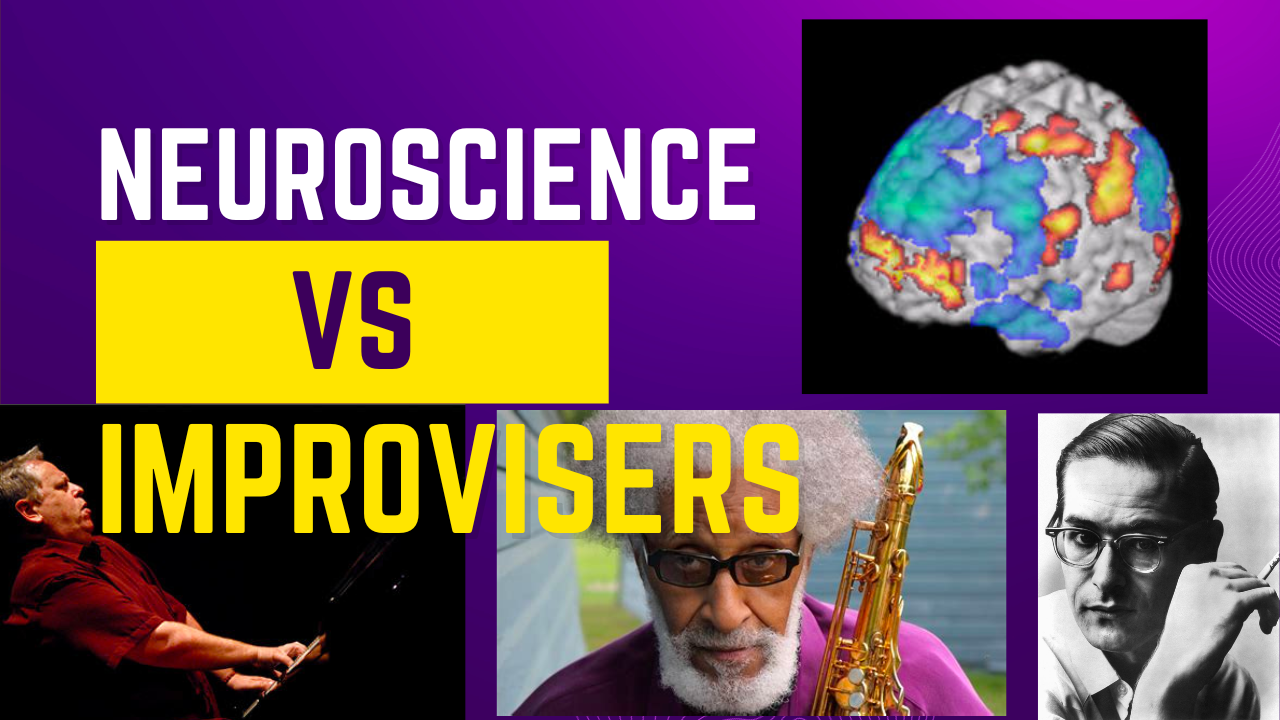
This episode shares overviews of seminal neuroimaging studies that provide insights into what happens in the brain during improvisation. You will learn how these findings align with what improvisers say about their experiences, including remarks from Bill Evans, Sonny Rollins, Kenny Werner, Pat Metheny, and Gary Burton. Cross-cultural perspectives are included here, as well, including reference to a traditional Japanese visual art form and traditional perspectives from West Africa.
References for the episode:
Kind of Blue liner notes by Bill Evans: http://albumlinernotes.com/Kind_of_Blue.html
Saxophone Colossus documentary about Sonny Rollins: https://www.imdb.com/title/tt0196073/
Full interview with Kenny Werner: https://www.youtube.com/watch?v=qsPg5lu4WCg&t=2318s
Pat Metheny at the Society for Neuroscience conference in 2018: https://youtu.be/yhAbNv1gJT8?si=uMgB-MxmrciyKBAN
Gary Burton’s Improv Class: https://youtu.be/t2txO_u2eNg?si=CBd6uc52UqxBOYz6
Limb & Braun, 2008: https://journals.plos.org/plosone/article?id=10.1371/journal.pone.0001679
Liu et al., 2012: https://www.nature.com/articles/srep00834
Rosen et al., 2020: https://www.sciencedirect.com/science/article/pii/S1053811920301191
Rosen et al., 2016: https://www.frontiersin.org/articles/10.3389/fnhum.2016.00579/full
Malidoma Somé: The Ancestors’ Gift of Healing: https://youtu.be/io28LgxYRf0?si=9ZX63gP4qtiI3s7t
Unedited transcription of the episode by Otter.ai:
Bradley Vines 0:00
Greetings, and welcome to the neuroscience of improvisation. In this episode, we are finally wading into scientific research. I will share overviews of seminal neuroimaging studies that provide insights into what happens in the brain during improvisation. You will learn how these findings align in interesting ways with what improvisers say about their own experiences, including remarks from Bill Evans, Sonny Rollins, Kenny Werner, Pat Metheny, and Gary Burton. There are also cross cultural perspectives included here, including reference to a traditional Japanese visual art form and traditional perspectives from West Africa.
Let’s jump right into the most famous improvisation neuroimaging study. This was conducted by Charles Lim and colleagues. He was at the time at Johns Hopkins. He’s now at the University of California, San Francisco. And what he did was to have jazz pianists. So these were professional improvisers. He had them play in two different ways in an improvisatory way. So they’re improv improvising over a 12 bar blues form, for example, versus having them play a pre memorized piece over 12 bar blues forms. So that was the comparison looking at improvisation versus performance that has similar complexity in terms of the motor requirements for the task. But it’s pre learned. So pre learned versus improvisation, or you don’t know, of course, what’s going to happen, creating it in the moment. And what he found us was quite interesting. And, to me, strike me as a bit paradoxical. So I would have thought that improvisation would require more brain activity. After all, it seems more complex, you’re having come up with something in the moment, you’re having to create something new. But actually, what he found was the dominant finding the most interesting finding at least, was a dampening down of activity, there was less activity in a certain area of the brain, that it well, it’s the dorsal lateral prefrontal cortex, that will come up a few times, but it’s here in the frontal cortex. And that is the area that is responsible for self control, rational conscious monitoring, and, and so on. So this area of the brain that’s normally active to help filter what we’re doing help keep us in line so to speak with with the norms of the situation was dampened down interestingly, and there was a concomitant increase in activity in areas involved in sensation and internal motivations, including the medial frontal cortex, and areas of somatosensory cortex. So there’s, there’s this trade off, it seems, where in the impervious Tory state, you have a decrease in self monitoring, and control volitional control, and an increase in the structures that are involved in internal motivation. Notably, Lou and colleagues found a similar finding a very similar pattern and results. We’re looking at freestyle rappers, so people that were not jazz pianists, but freestyle rapping artists, and they again compared pre learned versus improvised states performance situations, and found a very similar pattern to those that lemon colleagues found. Okay, now, the story isn’t quite so simple. As you know, just stop using your your self monitoring, and you’ll be a fantastic performer and you’ll rise to the occasion. Turns out that it’s likely that the story is related to your level of experience and also familiarity with the current situation. So David Rosen and colleagues did some very interesting research, where they looked at the quality of the improvisation. So not just whether someone was improvising but how or high the quality or enjoyment or pleasure of that improvisation was based on the performers own experience, but also listeners. And what they found, in some ways does go along with what Charles Lamb and colleagues found in that. When there was decreased activity in frontal regions, the more experienced improvisers had higher quality improvisation. So there was this correlation where the less activity in the frontal areas led to higher quality. However, this was only for the experienced improvisers. less experienced experienced improvisers saw exactly the opposite trend. So the less activity in frontal regions, the less quality in the improvisations. So it’s quite interesting to see that this involves familiarity and experience. And basically, there was a replication that Roseanne and colleagues conducted where they actually stimulated this prefrontal cortex area, using a technique called transcranial direct direct current stimulation, which allows you to increase or decrease activity in an area so they increased activity in the dorsal lateral prefrontal cortex of the right hemisphere. And they found that this actually impeded quality for the experienced improvisers, whereas it actually improved quality of performance for the less experienced improvisers. So. So the story is that using these frontal self monitoring areas might be very helpful. When we are less familiar with a particular situation, or with a particular piece that we’re performing through or structure. Think of when you’re learning to drive, of course, when you first start, you want to be quite vigilant and concerned about what you’re doing, where you’re putting your foot and so on. But over time, that falls to the background. And you’re able to basically do that implicitly. And that’s more or less what we’re seeing evidence of here in the context of improvisation. So what we’re seeing here is a pattern that connects improvisation with the idea of expression, spontaneous expression, without filter, so to speak. And this is probably not a new idea for all of you. One of the most famous albums of all time, of course, kind of blue features, liner notes by the incomparable Bill Evans, who beautifully writes in these liner notes, about impromptus, Satori, Japanese visual art form, these artists must practice a particular discipline, that of allowing the idea to express itself in communication with their hands, in such a way, such a direct way that deliberation cannot interfere. So this nicely aligns with what we’re finding thus far in, in this young burgeoning field of research on the neuroscience of improvisation. And you’ll find lots of statements that are like this across musicians. But certainly Ron says it as well as anyone else, you know, what I’m basically trying to do is blot out my mind. And of course, I’ve already learned the materials, it’s just letting the material come forth. This is from a great documentary, saxophone Colossus, and it aligns with what Kenny Werner is saying, in effortless mastery. If
Kenny Werner 9:06
I witness the piano being played, well changes in neurology quite a bit. So it’s not my responsibility. You could simulate it by watching someone else move their hands on the piano. And notice that you’re not involved at all. Because in your mind, you’re watching someone else play. Then you just look oh, look, his hands are moving. And I feel in no way responsible for where they’re going. The neurology of the first two steps is to be able to experience that, although it’s you so it has the neurological component of surgically removing the responsibility.
Bradley Vines 9:49
The jazz guitarist Pat Metheny has also discussed improvisation in a similar way. Here is a quote from his presentation At the Society for Neuroscience conference in 2018,
Pat Metheny 10:05
I want to be able to really be in the moment, at the most micro level possible while essentially being almost removed from it. I often describe my relationship to at all as being a fan of music a listener first. At my best, I don’t even feel like I’m doing anything. I’m just standing there listening. And if there happened to be a guitar player there, which there is, and it happens to be me, what would I like to hear that player do and then I play that. But the entire process I just described happens in almost real time. less than a millisecond, I would say, Gary
Bradley Vines 10:41
Burton, the wonderful jazz vibraphonist and educator, put it this way.
Gary Burton 10:47
And now when I start to play, I sort of take a mental step backward in a way and I start watching the playing. Soon as I started tune, I mentally I’m just watching the plane go down as if someone else is playing. And my conscious mind is disengaged from choosing notes and all that sort of thing. The rule is, the conscious mind can do anything it wants to, except get in the way. You can think about random stuff, you can watch the music happen, you can concentrate on the tune, feel and so on, but you can’t interfere with the flow. The following
Bradley Vines 11:30
is a comment about what seems to be the same state of mind you’ve just heard described by improvisers. But from a very different cultural context, that of a community in Burkina Faso, West Africa. You will hear Dr. O’Malley DOMA. So me talking about the traditional perspective on performance more generally, that is not limited to music or improvisation, but including all human endeavors. So
Maladoma Some 12:00
it really raises the issue of, of knowledge. That’s why I’m saying that, you know, it’s, it raises an epistemological challenge here. Is that you the know how to do what you do?
Bradley Vines 12:15
Or is it something else that is doing the thing and knowing the doing and therefore taking over your hands, your feet, your mouth and your whole body? In summary, we have explored some interesting correspondences between what’s happening in the brain during improvisation and what improvisers report about their experience. We have opened the door to cross cultural perspectives on the states of mind. And going forward, we will delve deeper into the neural mechanisms underlying improvisation and what they reveal about the relationship between improvisation and dreaming meditation, psychedelics and consciousness more generally.

 THE NEUROSCIENCE OF IMPROVISATION